Update: Roger that!

May 4, 2011

As you probably remember, what should have been Roger Hammond’s season highlight – Paris-Roubaix – ended in a hospital bed. He sent me this update and allowed me to share it with you (Roger’s wife works in a hospital, so you’ll notice Roger takes particular interest in that area!):

Just a quick update…

The good news… I’m finally starting to heal now. The stitches are out and I have to say the hospital in Valenciennes did a great job, quite a neat scar when you take into consideration what they started with. And no sign of infection. Although I was on a huge dose of antibiotics for 8 days just in case. The reason for such a high dose, they weren’t taking any risks. They let me know just before they took me to surgery, they’d had a rider in about 8 years ago that had a really nasty infection after crashing in Arenberg. I guess they were trying to make me feel better about the impending surgery!

The bad news is I still have a lot of pain in the elbow joint itself and it is still swollen. I’ve been waiting for improvement but it is a lot slower than anticipated. I’m starting to get impatient so I’m going to see Matt (team chiro) to get his opinion on how best to treat the injury. I subsequently found I had broken a rib in the crash too, which just added to the sleeping difficulties!


My own 2011 Paris-Roubaix Tudicula

April 18, 2011

Tudicula means “small hammer”, it was the first word that popped up in Google when I was looking to distinguish my little Paris-Roubaix 2011 ride from Johan Vansummeren’s. We went with the office to Paris-Roubaix and rode the Arenberg forest and then to the finish on the Velodrome.  16 pavés, and I honestly think it may be a tougher test for the equipment than when the pros ride it, because at our slow speeds you really hit every bump instead of flying over half of them.

So my logical choice was the R5ca. It just happened that there was a show model from Eurobike sitting in our office and I it was roughly my size, so why not put it to good use. This particular frame was a size 56, with the stock fork, 3T Team arbon seatpost, carbon handlebars and alloy stem, SRAM Red groupset, Rotor cranks and Zipp 202 wheels. Most of the group rode the 303, which was really designed with surviving Roubaix in mind (yet being very aero and light as well). But I was fairly sure the 202s would be OK as well as that’s what Thor rode in 2009. Tires were of course the 27mm Vittoria Pavés, which again got our group to the finish without any flats.

The bike performed flawlessly, no problem whatsoever. I can’t say I was surprised as obviously I know all the test results of this frame, but still, to ride Roubaix on a sub-700g frame was neat. Next year maybe we get the team on them, this year that simply wasn’t possible given our limited production volume and long waiting list (luckily for me the show model I rode was one iteration removed from the final layup so not sellable).

Here’s the whole bike (note: I took the photo back at the hotel and put the wrong front wheel back in, a 303):


Fabian’s Flipside

April 17, 2011

Another Spring classic, another thought on Fabian. Let’s face it, he is the man around whom all the Classics revolve so far. With his decision to participate in the Amstel Gold Race, will this one be any different?

There are actually two BIG differences. First off, he’s not the favorite, Gilbert is. Secondly, he’s on arguably the strongest team in this race, not one of the weaker ones.

What isn’t so different from last week, ironically, is the type of race. Sure, Roubaix is flat as a pancake with horrible roads while Amstel has 3,000 little climbs and the world’s largest collection of road furniture (when did that stop being called speed bumps and road signs?). But for a rider like Cancellara, that hardly matters as he excels in both (witness his performance on the Poggio and the Leberg).

More importantly, Amstel and Roubaix are the two races most prone to the dozen little groups scenario, almost every year these races explode in small fractions and the accompanying tactical chess game of who’ll rides and who won’t. Which in turn means it’s all about the numbers. If Cancellara jumps away alone or in a small group, who will chase him down with one or both Schlecks (likely one as the other will invariably crash in Amstel) on their wheel? My guess would be that eventually, nobody will fully commit, and instead the chase will shrivel in self-pity and frustration. Not unlike Roubaix of course.

The only question mark over such a scenario is Fabian himself. He was strong all the way back at Milan-SanRemo, is it possible to still be strong today? Or is the candle burnt up after E3, Flanders and Roubaix? Boom or Bust, not much in the middle.


Johan’s 2011 Paris-Roubaix hammer

April 15, 2011

Here we have Johan Vansummeren’s Paris-Roubaix-winning R3. The frame is the new, 2011 model, with BBright, Squoval tube shapes, razor-thin seatstays and the tapered headtube.

The new BBright, Squoval shapes and tapered headtube all focus on geometric improvements to get more stiffness and strength out of less material.

  • BBright widens the bearing stance where possible (non-drive side) and enlarges the crank axle.
  • The tapered 1 3/8″ headtube increases the fork steerer side at the bottom without making it too stiff which is a risk if the diameter is 1 1/2″. It may sound like too stiff is not possible, but actually it would make it too harsh a ride and prone to impact failure.
  • The Squoval shapes on the new R3 (and R5(ca)) are part of our continuous improvement process, not a single shape on the frame is unchanged from the original (and Paris-Roubaix 2006 & 2007 winning) R3.
  • The razor-thin seatstays are actually even thinner on the 2011 models than they were on the first generation R3.

What’s quite unique about Johan is that he is the first pro rider who is on our biggest frame, the 61cm. Although this should come as no surprise given his 198cm/6ft6 stature.

Completing Johan’s bike are the prototype Mavic wheels and the biggest “27mm” tires I have ever seen. Compared to the “27mm” Pavés, these are enormous. The Pavés fit the standard R3, these sausages don’t  (nor do they fit any other normal road bike for that matter). Hence we raised the brake bridge slightly and lengthened the chainstays by 5mm. Other than that, the R3 frame is standard geometry and layup.

The Sram Red group, Rotor 3D+ BBright cranks, 3T Arx Team stem and Rotundo bars are all standard parts, as is the new 3T Palladio Pro seatpost. It’s got a unique system to lock the saddle in with vault-like security, really a neat design. You set it and forget it, as they would say if it were a rotisserie grill.


The horse is dead, long live the horse

April 14, 2011

It seems to me the Paris-Roubaix tactics horse shows extremely weak signs of life, but I keep getting questions and I don’t want to be so rude not to answer them. Therefore, one last round (and most of the questions have some novelty to them). So, Dominic asked:

Let’s say there are no race radios and the same situation would have happened with JVS at the front, Thor and Fabian in the second or third group with 40 km to go. Fabian would have probably attack and Thor would have followed because he couldn’t be 100% sure that is teamate was really at the front. He would have attacked with Fabian and that would have been the best thing to do because strategy would be less important without earbuds. At least, harder to put in place. What would have happen then? The best rider would have won. Fabian or Thor, nobody knows!

First of all, Thor WOULD know that JVS is in the front, in fact Garmin-Cervelo has ridden every classic as if there are no radios. Just study the tapes, you will see that they are always close to each other when it matters. It makes a ton of sense if there is a mechanical (as Boonen can attest to) and for tactical reasons. So in that sense, the tactics are the same. JVS would ride in the front saying he doesn’t have to work because Thor is behind, and Thor would not have to work because JVS is in the front. Racing has been like this since long before radios, this is not some new tactical invention. Then Jpmikkelsen asks:

I did not understand why Sep Vanmarcke had to help Fabian at some point. Why did you guys do that?

Jonathan Vaughters answered that to Podiumcafe: “We wanted the gap to be tight (40secs) so the others in the break were forced to work hard. And… so that Fabs [would] think he could get across towing Thor. A big gap (2mins), the break starts to look at each other, and [Fabian Cancellara] gives up.”

It all comes down to that Hennie Kuiper quote (you know, the guy who raced before there were radios), about finishing everybody else’s plate before you start your own. And the thing is, for the people who claim that Cancellara was the strongest and that Thor should have helped him, I still haven’t heard a single tactical scenario where helping Cancellara leads to Thor winning.

Sprinter vs. Rouleur

April 13, 2011

Well, that Paris-Roubaix certainly unleashed some emotions. Some are upset with Thor for not working with Cancellara. Five things on that:

  1. Thor had his teammates Sep Vanmarcke and Gabriel Rasch work to narrow the gap on the front group. Why didn’t Cancellara have his teammates help? Oh that’s right, they weren’t there. It’s not Thor’s fault that Cancellara moved to Leopard, he had offers from Sky and BMC, both of which have strong classics teams.
  2. When the gap wasn’t closed, should Thor do the work himself to close down the gap? I think it has been the case for 100 years that if you have a sprinter and a rouleur, the rouleur needs to try and drop the sprinter before they get to the finish. Remember Paris-Roubaix with Van Steenbergen and Coppi out in front? Van Steenbergen won the sprint (expectedly) but said afterwards: “If Fausto had jumped one more time, I would have had to let him go, I was done.” To which Coppi replied: “If I had been able to jump once more, I would have.”
  3. It seems Cancellara and l’Equipe feel that Thor should pull Cancellara to the front group and waste his energy so that Cancellara can then jump away from him. Only a dumb rider would do that, and Thor ain’t dumb.
  4. If Cancellara was really that strong, he would have dropped Thor on the cobbles. He didn’t, in fact Thor followed with relative ease. Now he dropped him on the final drag. Thor was caught out of position there and made Flecha try to close the gap first, who couldn’t. Could Thor have? If he had been in position, maybe.
  5. In the end, Cancellara can complain all he wants but he himself chose his team, he chose to show off his strength at E3 and make himself the absolute top favorite. Despite that, the other teams basically handed him the win in Flanders with their early-race tactics but he over-estimated his strength in trying a 50k breakaway. In Roubaix, I don’t think he was on Superman form and combined with being outnumbered it was going to be very difficult in any scenario. I can understand that he is frustrated for being the strongest rider in the Spring and not winning any of the big races, but he can’t complain that his competitors didn’t help him. Last time I checked that’s not their job. Maybe he’ll do Amstel and/or LBL and win there.

The honor of betrayal?

April 12, 2011

Andrew Hood wrote an insightful piece for Velonews about Garmin-Cervelo’s biggest win, Vaughters and the tactics that made it happen at Paris-Roubaix. It’s really worth a read. The part where he quotes l’Equipe is hilarious:

Hushovd honored the unwritten code of not attacking a teammate up the road, something that lesser riders might not have done, but L’Equipe — the respected French sports daily — didn’t quite see it that way. In Monday’s edition, the paper gave Hushovd a one-star rating out of 10, writing: “Hushovd didn’t respect the rainbow jersey. He wanted to play hide-and-seek with Cancellara. Luckily for him, Van Summeren (won). He earns one point. One.”

I’m not quite sure how to read this. To get 10 stars, you need to betray your teammate? Of course, all sorts of jokes related to the country l’Equipe hails from spring to mind, but let’s not forget that it is France that gave us this most beautiful of races to begin with so “Vive la France, Vive le pavé.”


What a difference a day makes

April 11, 2011

On Saturday, Garmin-Cervelo’s Spring Classics season was dubbed a failure, 24h later they appear one of the big winners. What a difference a day makes.

So, does this mean the results are now the only thing that matter (which I had answered negatively in this blog)? Of course during a race the result is what matters, but afterwards, it makes more sense to evaluate the process. Even if you win.

Personally, I think the team rode the strongest race tactically in Flanders, but that wasn’t very visible. In Roubaix the tactics were very complicated (they usually are because there are so many small groups and the situation is so fluid). It’s impossible to get all the calls right, but as long as the majority of the tactical calls are correct you’ll be OK. And the one crucial call that had to be made was made and Johan jumped clear of his group while Thor demoralized the group of the big favorites. If Johan had finished second instead of first, would the evaluation of the team’s tactics have to be diametrically opposite of what it is now? Of course not.

Speaking with Thor, Gabba and a few of the other riders afterwards, you realize just how strong they all were and how much they sacrificed their own chances for the team’s success. In fact, hearing from them how strong they felt really increased my admiration for them even more. In a way, the winner has it easy.


Thor’s 2010 Paris-Roubaix hammer

April 8, 2011

One year after that awesome 2009 Paris-Roubaix, Thor was back. The RS was not allowed by the UCI (the comfy curves in the RS were deemed to violate a little rule (straight line has to fit inside the tube) Even though much bigger offenders like the 2011 Orbea Orca are allowed to be raced right now, we didn’t want to risk anything in Thor’s pursuit of his ultimate dream race.

So he rode an R3, this time with SRAM Red group and Zipp 303s. As a note, he also started on Zipp 303s in 2009, but a bike change 100k in meant he rode all the cobbles on 202s, quite a performance for that wheelset.

As we all know, Cancellara won the race, Thor finished second and Roger Hammond finished fourth. You can see Roger give his view on this race DURING the race here.

And Thor’s bike is here:


Thor’s 2009 Paris-Roubaix hammer

April 7, 2011

In 2009, the first year of the Cervelo TestTeam, Thor made Paris-Roubaix his main goal. Shaking off his sprinter image, he started dreaming of this race back at the winter training camp. He was right on track with his third place finish at Milan-SanRemo, and was again sprinting for third at the Tour of Flanders (in both cases behind Heinrich finishing second) when disaster struck. Instead of finishing third, he was taken down in the sprint and hurt his wrist and thumb. You can see the pretty funny post-race-beer-drinking-with-neck-brace scene here.

Anyway, he went into Paris-Roubaix tentatively, but performed brilliantly despite not being able to use his left hand. He was leading the race with Tom Boonen until that faithful left turn at Carrefour de l’Arbre. That you can all see here.

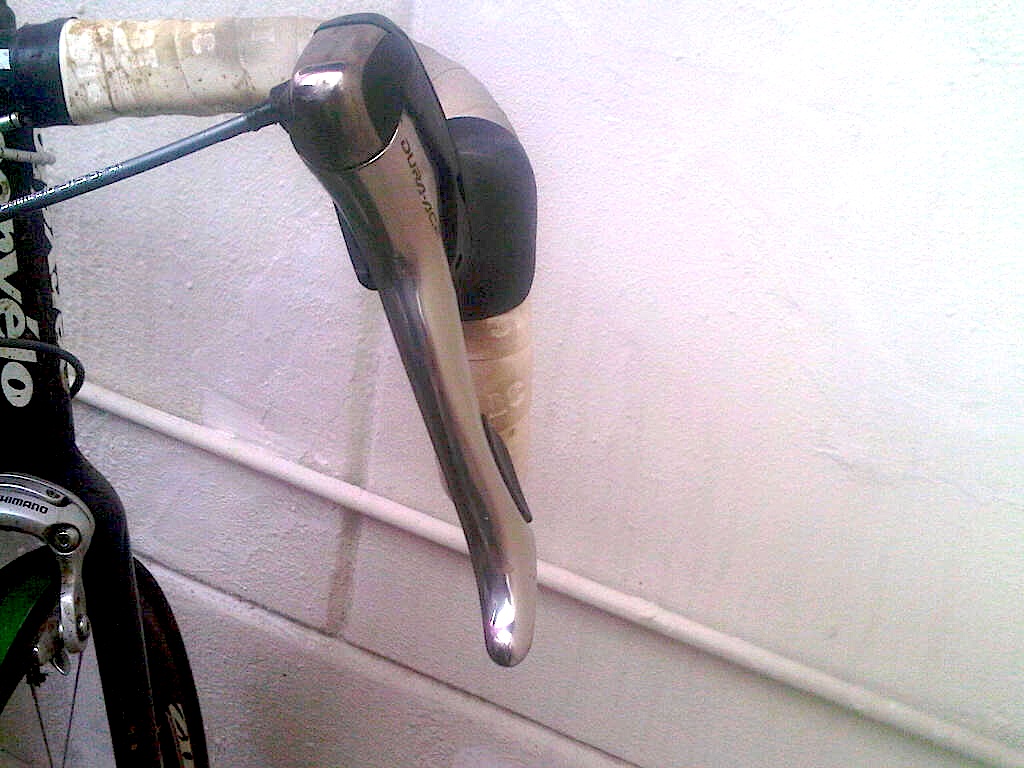
In the end, he finished 3rd. This is the bike he did it on, with a stock RS frame. As you can see, the shift lever is still crooked from his crash.