Archive for the 'bike politics' Category

Leo-Shack Clue – the board game

August 31, 2011

I hope you all enjoyed me not writing for two weeks as much as I did.  In case you were expecting a follow-up on the biological passport, I want to be thorough so I sent a question to the UCI for clarification (you may remember they mentioned that a simple call could have solved any mystery, so I’ve decided to follow that course of action. I hope they come through).

But what a fun moment (insert sarcasm) to come back, with all these rumors flying around. This time it’s Leo-Shack. One thing stood out for me in the cyclingnews article:

There are 27 riders under contract at Leopard Trek and 13 riders under contract at RadioShack.

For a team to have only 13 riders under contract halfway through the Vuelta is very unusual. Possible reasons:

  1. You have an enormous problem with your rider group. While there are certainly things to point to (Armstrong investigation, the average age, etc), I don’t see anything that would require replacing half the riders on that team. And if this were the case, you’d be hiring like crazy right now.
  2. You don’t have sufficient sponsorship funds for next year to make new commitments.
  3. You’re planning a merger and combined you have too many riders.
  4. You’re a mad genius and have a plan so brilliant nobody understands it.

Obviously this list is not exhaustive, but I struggle to find other logical reasons. In the current situation, it may very well be a combination of #2 and #3. Obviously very few people know the whole story, but the clue about 13 signed riders is too big to ignore. I’ll put my money on Bruyneel, in the kitchen, with the knife.

More on this topic later today, to always get the latest you can subcribe to this blog by email, twitter, facebook, even Skype (don’t ask me how that works).
Biological passport follow-up

August 11, 2011

Thanks for the response on my blog from yesterday about the significant reduction in testing for the biological passport. I also see the need to clarify some things:

  1. I did not say there were zero tests, just that I’ve heard from riders and team managers that they haven’t seen tests being carried out, while nobody told me the opposite. And that’s a stark contrast to say 12 months ago. Obviously I did not check the 1000+ pro riders all individually.
  2. Daniel Benson reports that according to the UCI, some tests were carried out at the Vuelta, Worlds and Leopard training camp. I have no reason to doubt the UCI on that. I am not sure if that is the complete list, because if it is, then that would confirm that the number of tests has been greatly reduced.
  3. Andrew Pinfold, a rider for United Healthcare, also reports being tested for the passport. I think the team he is on in 2011 is in a different category than in 2010, so that may have something to do with it.
  4. Some people saw my post as a bashing of the UCI, but actually it is quite the opposite and therein lies part of the problem. As long as people see the biological passport as a UCI thing and therefore look at them to solve any issues, it won’t work. Riders, teams, races all have to understand how vital the biological passport is and find a way together to make it work. Some are actively supporting the UCI, others are not.
  5. The point is not if 0, 100 or 500 tests were carried out in the past year, the point is if the sport is able to support the number of tests necessary to ensure most people play by the rules. And if that ability is threatened, then action should be taken.
For future updates, you can subscribe here.

The biological passport

August 10, 2011

This has been bugging me for a while, not sure what to do with it. I’ve mentioned it to a few real journalists, and some others have called me with questions. I’ve been quite open with them because I feel it is important for the sport, which seems to be at a cross-road. Here’s what I’ve told these journalists:

I have not heard of a rider being tested for the biological passport between the end of the 2010 Tour and April 2011. After that I am not sure. While it is logical that the frequency of testing might decrease somewhat once profiles are established, the fact remains that the profile in itself is not a deterrent. The deterrent comes from testing current values against those profiles to see if there are clues indicating doping.

If what I have been hearing is indeed the case throughout the sport, then that would be worrisome. It would mean that in a crucial build-up and competition period, only riders who were on teams with independent anti-doping programs (such as HTC and Garmin-Cervelo) have been properly monitored to the extent that science is capable of. And it’s why I tweeted earlier that teams claiming they don’t have to do anything because there is the biological passport are, well, what’s the word?

Apparently defending biological passport cases in court is expensive, and in my eyes it points to a flaw in the set-up. When you come up with a new process, you have to make the riders’ rights the top priority. Only that way can you minimize costly challenges. The simple fact that riders don’t have access to all the data used to convict them risks turning the biological passport into sport’s version of military tribunals. I’ve written about this before.

I don’t think there are necessarily bad intentions here, but if the teams are paying a ton of money to fund the biological passport and all that money goes to defending cases so there is little money left for further testing, then riders, teams and federations have to sit together and figure this out, rather than just letting the biological passport die. It’s in everybody’s best interest to do so. And it gives the sport a chance to not only be the first to set up a revolutionary technology, but to also be the first to integrate it in the sport in a fair, sustainable way.

If you want cycling to continue to lead the way in the anti-doping struggle – no matter how hard – and not give up on the passport, then please spread this story. Thanks.

For future updates, you can subscribe here.

HighRoad lessons learned

August 5, 2011

I wanted to write a blog about the demise of HighRoad, but it’s too depressing. Whatever you may think of Bob Stapleton (and certainly I have some positive and some negative thoughts), I’ll remind you of two things:

  1. He was and is a huge supporter of women’s cycling. Even now that the team will fold, he’ll find a way to keep the women’s program going. I’m sure of it.
  2. He took a team that had become a mess in the public eye and turned it into an exciting team with lots of antics on the road and very few off it.
Maybe next week I’ll muster the energy to go into the lessons learned. For now, I hope you all enjoy a good ride on the weekend.

2 answers on 2011 speeds vs cleaner cycling

July 19, 2011

I got asked quite a bit after my blog yesterday whether or not the status-quo on Plateau de Beille indicates a reduction of doping in cycling. My answer would be two-fold.

  1. I think no such conclusions can be drawn from how the stages unfold this year. As I pointed out yesterday, Both Andy Schleck and Contador have had decidedly different lead-ups to the Tour this year compared to 2010, so it would not be surprising to see them ride slower. Of the other 8 riders in the 2010 top-10, seven have crashed out of contention or aren’t here for other reasons. Only Sammy Sanchez is there this year (and he also has had quite a different preparation this year). So how do you really compare the level between the two years.
  2. However, when you look at the data, you can see interesting trends. The sportsscientists.com article I referred to yesterday shows that the climbing has gotten consistently slower in the past few years, and their excellent article on the biological passport shows an encouraging trend. Of course, while this indicates a cleaner sport, one has to be careful with the definition of “cleaner”, as they point out as well.

Either way, it doesn’t really have anything to do with whether or not one rider can gap another. The sample of 5 top riders is simply too small, the outside influences too large and the data doesn’t apply exactly to them. After all,the sportsscientists.com’s data deals with the entire population, while the way the front of the race unfolds depends on individual riders (see point 1 above).

Furthermore, the data shows a big shift between 2007 and 2008, but we’re seeing a change in “gapability” between 2010 and 2011. Maybe once sportsscientists.com has 2011 data we’ll see a difference with 2010, but for now there is no evidence that cleanliness of the top riders has changed between 2010 and 2011. There is only evidence it has changed between 5-10 years ago and today.

The weirdest argument I’ve heard is that cycling must be cleaner today because there is a French contender again. As if the French never dope! France has its fair share of confessed doper Tour de France winners (Fignon, Thevenet, Anquetil). Even as recently as the Tour of 2008 (when the test for CERA was introduced without warning), we had a French rider leave the Tour with some vague injury after proclaiming a grand attack the evening before.
The only difference is that with a French rider, they don’t ask for the jersey back the way they did with Riis. Instead they give them a job as announcer or chauffeur. Don’t get me wrong, there are definitely some French teams with a great attitude, but it’s not black and white.

Race vehicle follow-up – team cars

July 13, 2011

Many of you agree that the team car can go, which is quite surprising to me. You like the idea that such a change would likely encourage bike manufacturers to put more emphasis on durability, which has real benefits for regular cyclists. The most concern people seem to have is for the sponsors (thank you), on issues like:

  1. “A sponsor would not be happy if a rider wins on a neutral support wheel or bike”. First of all, this happens already, albeit rarely because the team car is usually there. But the principle won’t be new, just the frequency.Secondly, this is exactly what you would want. If the sponsor is unhappy that the rider used neutral support equipment, you can bet they will focus on durability more. As a result, the neutral support equipment use will shrink, and everybody will be happy again.
  2. “How can you fit a rider on a neutral bike with different pedals, etc.” No doubt, this may be a bit tricky. But then again, it’s just an incentive to make sure your stuff doesn’t break. And you can put pedals on a bike in 30 seconds, that’s a lot better than being out of the race.
  3. “Each team has its own energy drink sponsor, you’ll need tons of neutral support to give each rider their own bottle.” Maybe, maybe not, if it’s just about bottles, then quite a few different ones can fit on a motorcycle. Alternatively, there could be one central energy drink sponsor (like in Ironman races for example) supplemented with team support in feed zones (similar to the special needs bag at Ironman). If you’re afraid feed zones are too dangerous too, toss in a maximum speed (like the F1 pit lane).
  4. “Teams have energy drink sponsors, so revenue will be lost.” This revenue is quite small, so it would be a very small price to pay for safety. In reality, this set-up would allow the race to sign a large energy drink deal, and create a revenue-share with the teams for probably a net-zero or net-positive result.
  5. “Where do all the rain jackets go when the weather changes?” Well, where do you put yours when that happens? Doesn’t seem to be a problem for millions of cyclists to carry their rain jacket. Some cycling jerseys even have pockets in the back! :-)
What do you think? As usual, let me know in the comments section below or on twitter @gerardvroomen.

Race vehicle follow-up – photographers

July 12, 2011

“Too radical, won’t work”, some say about the idea to reduce the number of vehicles in the peloton (though fewer say that today than when I first posted it in May). But the idea isn’t really radical at all. I’ll go into some more detail in the next few posts, based on your feedback and questions:

  1. “But we love the photography”. So do I, and my proposal would not reduce the number of photos you see in the media and hardly the variety.
  2. “You need this many photographers in order not to miss anything.” If the goal is really not to miss anything, then you should spread them out. But instead many want to be in the same place to shoot the same photo, and that’s exactly where the problem occurs. You can’t let 16 photographers into the race for wide coverage, and then have them all in the same spot “because that’s the photo the media want”.
  3. In reality there are two groups of photographers; those who capture the actual racing, and those who capture the special moments, the artistic side. You don’t need too many of the first group, as is proven already today. Right now, only 3 photographers are allowed to work the final portion of each stage, and they then share their photos with the rest. If 3 is enough to cover the most exciting part of the stage, wouldn’t it be enough for the rest of it too?
  4. “Variety will be less”. Given that these photographers are all fighting for the same spot to take the same photo, there is no variety now. In fact, photo quality probably suffers because of the fight needed to take it. Plus there is the other part of the proposal:
  5. Assign 2-3 photographers to take the artistic photos (and no, I don’t mean another sunflower shot), not in the thick of the action but around it, where they won’t affect the race flow.

Bottomline, the sport needs to take decisions for the betterment of the sport. Those decisions shouldn’t unduly penalize photographers or anybody else, but on the other hand we also cannot allow the sport to be hurt for the benefit of these other groups.

What do you think? Let me know in the comments section or via twitter @gerardvroomen. To ensure you get tomorrow’s follow-up post, you can subscribe here.

Race vehicles recap

July 11, 2011

You may expect a post today about the ridiculous stage from yesterday, but honestly I’m lost for words.

Most of you already know my opinion on vehicles in the race and I think it would be best to just stand by the words written with a clear mind back in May rather than just jumpng on the latest fad. Here are the links to that series:

Anyway, let me just finish by saying how proud I am of Thor’s accomplishments in the first week. Simply amazing work by him to keep the jersey as long as he did. Too bad he lost it through such a crazy stage but that actually only highlights his character.
On the theme of magnanimity from last week, Thor is the only rider I can think of who has now twice waited for fallen riders and thereby given up a jersey. Remember that last year the waiting on stage 2 cost him 30 very dear points for the green jersey. Respect.

Cycling copies Football/Soccer

July 7, 2011

Cycling often looks at soccer with envy. The teams are rich, the federation is rich, doping scandals disappear before they get any traction and 7-figure donations are made from the federation to WADA instead of 5-figure donations from the athlete to the federation. So it’s disappointing that what cycling seems to be copying from football right now is the one thing we all detest: incomprehensible refereeing.

First we saw stage 1 time losses still being adjusted 3 days later. Then there was the Cavendish-Hushovd intermediate sprint, now there is the Rojas-Boonen sprint. Not only the calls themselves raise questions, the timing makes it all even worse. If you have an intermediate sprint at 2pm, can you really not review the tape and make a decision before you have the jersey ceremony at 6pm? How long does a video review take during an (ice) hockey or (American) football game? 30 seconds?

Any fan with a Twitter account and a Youtube connection can make these calls more efficiently (if they were calls to be made to begin with) than is currently happening. That said, if it takes five hours to review a video, we shouldn’t be surprised it takes 12 months to review a doping case.

Zomegnan for president

June 30, 2011

Yesterday I talked about my lack of enthusiasm for the 2011 Giro. An hour later I read that Zomegnan has been forced out as director of the Giro. It’s not my blog’s fault, really!! In fact, I am very sad to see him go.

Rumor has it that Italian TV broadcaster RAI thought the 2011 race was boring. You may think I agree with that based on yesterday’s blog, but I think RAI has gotten spoiled. The fact is that the Giro has always been hard, both the stages and the transfers in-between. To get an exciting race, you need an imaginative course and a bit of luck.

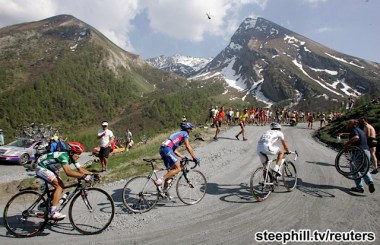
Zomegnan consistently creates such imaginative courses, and even comes up with great themes (100 years of the Giro, 150 years of Italian unity). I have written about why the Giro rules in the past. It’s actually one of my better pieces, if I may say so myself, so maybe worth a read (see here). Aside from the points mentioned there, just consider these four highlights:

2005: Colle di Finestre. The whole race has been epic, but somehow Savoldelli has managed to create a comfortable lead in the overall. Then Rujano and Simoni take advantage of the gravel of the Finestre, while Savoldelli struggles. Simoni is within 4 seconds of the pink jersey at the top.

On the descent and the final climb Savoldelli manages to hold on and wins the Giro with a 28 second gap. Rujano 3rd at 45 seconds. The footage is absolutely amazing.

2008: Going in to the final Sunday time trial, Contador has just a 4 second advantage in the fight for pink. This Giro was so hard that Contador actually didn’t win a single stage!

2009: Start in Venice, Climb up Vesuvius, climb up Blockhaus, the time trial to Riomaggiore that took the winner more than an hour and a half to finish!! This Giro was epic. And as a bonus, it featured the most spectacular time trial course ever, through the cobbled streets of Rome past the Forum, the Vatican, the Colosseum, and it all ended with that infamous Menchov crash:

Of course, Zomegnan was “lucky” with that crash, but love it or hate it, he did manage to convince Armstrong to come race the Giro which resulted in a massive increase in interest. Has RAI forgotten that?

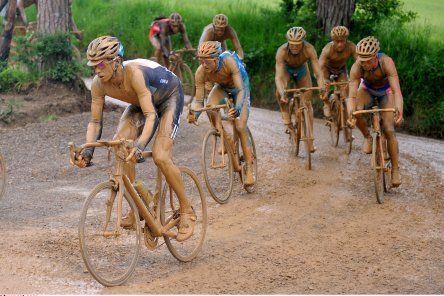
2010: Start in Amsterdam, Strade Bianche mudfest, 50 riders take 13min on the pink jersey in stage 11, Monte Zoncolan, Plan de Corones, Passo del Mortirolo, Passo di Gavia, finish inside the amphitheatre of Verona. This photo says it all:

It’s easy to look at the 2011 Giro and conclude it wasn’t the most exciting, but nobody scores 100%. As course designers go, Zomegnan and his team have done exceptionally. Maybe the Giro doesn’t need one director who is responsible for everything but please, please, please, keep a journalist like Zomegnan in the role of course designer and race philosopher.