Archive for the 'bike politics' Category

License to will

October 26, 2011

“Morally reprehensible”, “morally repugnant”, “Do not use the UCI license to force teams and organizers to do something”. Just some of the responses to my suggestion that WorldTour teams and races should be required to have a women’s team resp. race as well.

In my view, these people are missing the point. The concept that UCI licenses should not be used to force certain behavior is ludicrous. In fact, adjusting behavior is the ONLY objective of licenses. If you’re against any sort of governing body, any sort of license, OK, that’s consistent. But having a governing body doling out licenses and then saying you don’t want that to influence behavior makes no sense.

Every license has certain criteria attached to them. These criteria further the UCI’s agenda. Some criteria are related to health and safety, others to the sporting level, or to giving young riders and riders from underdeveloped regions a chance to get a spot on the world stage. You fulfill those criteria, you get a license. It’s actually one of the few ways in which a federation can influence behavior.

I didn’t hear anybody complain about some Iranian dude making a salary that could support an entire women’s team, just because he scored a bunch of points on the AsianTour and those points help Lotto to get a WorldTour license. It has nothing to do with the real sporting level of that team for next year, it’s a complete distortion of the ranking, but it’s in the rules to help develop the sport in regions outside of Europe (a crude method in my view, but that’s another story).

Yet if the UCI would start counting women’s ranking points towards the WorldTour status (a great idea from @inrng) instead of AsianTour points, all hell breaks loose. And that’s really a much better idea, since unlike the Iranian rider the women don’t have to race against the men the way this Iranian guy now has to.

It’s all very simple; either you don’t want any governing body doling out licenses or you accept that there are criteria to obtain such licenses and those criteria are aligned with the governing body’s mandate.

Even if you accept that the governing body can set criteria, that still doesn’t mean race organizers or teams don’t have a choice. The Tour de France didn’t like the ProTour, so they never asked for a ProTour license. Cervelo TestTeam didn’t like the ProTour, so it didn’t ask for a ProTour license either.

I’m planning a series on the unintended side effects of the current license process. It’s quite staggering actually, so if you’re interested, you can subscribe here.
Katushteiner

October 20, 2011

Lots of chatter on the airwaves about Hans-Michael Holczer going to Katusha. “How can a guy responsible at Gerolsteiner for Rebellin, Kohl, Schumacher and Levi (the latter according to statements in his own book at least) come back to cycling?” That sort of stuff.

I see it a little differently. Holczer has been trying to get back into the sport since Gerolsteiner collapsed at the end of 2008. Of all the ways that could happen, him going to Katusha is probably not so bad, isn’t it?

  1. Sure, Holczer was asleep at the wheel at Gerolsteiner when it came to the positive tests they scored in 2008, and according to his book did nothing when he was made aware of “suspicious values” from Levi. He famously remarked that an internal testing program was not necessary because he trusted his riders. But I personally don’t think he had any bad intentions (note: this is based on absolutely nothing but gut feel).
  2. At any rate, does a swap from Tchmil to Holczer really change the balance at Katusha dramatically?
  3. The cycling world wasn’t relying on Katusha to solve the doping issue anyway. The most memorable anti-doping moves from the team have been a completely unenforceable 5-year-salary penalty amendment to their rider contracts and the shipping of Kolobnev to the doping goulag without any form of process. I don’t think either are a meaningful contribution.
  4. It keeps things nice and tidy for fans. White helmet and black helmet teams so to speak. There was never much reason to like Katusha, now there still isn’t. I mean, has anybody every seen the words “Katusha fan” being used without them referring to the air-conditioning unit in their team bus?
I’d say black helmet riders and staff going to black helmet teams is a good thing, it’s a form of containment. It’s much more problematic to have white helmet riders and staff go to black helmet teams, which unfortunately happens a lot too. After all, especially for many riders there aren’t many options when picking a team, so they end up in an environment that is a terrible match with their own values.

This problem is as old as cycling itself. Remember Willy Voet’s book about the Festina affair? To me the remarkable part was not that half the team did everything the cycling Gods had forbidden, but that the other half didn’t.

Increasing races & exposure for women’s cycling

October 12, 2011

Organizing a race is expensive, which is why we’ve lost beautiful independent races like the Tour de l’Aude. Road closures, safety measures, broadcast facilities, it all adds up. The solution is still as simple as it is obvious, and I have advocated it before: Make it mandatory for every WorldTour race to also organize a women’s race.

The costs would negligible as everything is already organized for the men’s race. Fleche Wallone and the Tour of Flanders shows how to do it, with the women’s race is an hour or so ahead of the men’s race.

Not only is organizing a women’s race just before the men’s cheap, it’s also smart marketing. Remember how the UCI’s job is to promote the sport? What better way to do that than to expose the fans waiting for the men’s race to the women’s race first? Think of it as an opening act at a concert, most successful bands have started out as an opening act for somebody bigger before they flourished on their own.

Since there are plenty of boring moments during a bike race, the men’s race broadcast can also be combined with the women’s race without much effort or cost.

Most of you will know that I am also an advocate of making a women’s team mandatory for any organization fielding a WorldCup team. This too can be done at no cost, while at the same time making men’s racing more exciting (huh, what? yes!) That however is a longer story, so I’ll need to find some time to write all that up.

Whenever it’s ready, you’ll get it automatically if you subscribe here.

Female rider minimum wage: UCI actions

October 11, 2011

Pat MacQuaid stated at the World Championships that  women’s cycling was “not developed enough” for a guaranteed minimum wage. Some riders (Vos, Teutenberg, Bronzini et al) saw that as a disqualification of their performance but it wasn’t. It was a disqualification of the federation’s performance.

After all, international federations have been given a mandate by the IOC to govern and promote their sport worldwide – for men and women. So if the women’s side fails to develop properly, who’s to blame? In 2006, Pat McQuaid gave an interview with womenscycling.net where he stated:

[…] since I have been involved and responsible for women, it was important to ensure that we had the development of the World Cup. This was very much the major item on the agenda a few years ago. I also wanted to make sure that it was truly a World Cup and not a European one like the men’s competition. I have always worked hard within the UCI to ensure and maintain an Australian and New Zealand connection.

Today, the World Cup has no race in New Zealand or Australia, in fact 8 of the 9 races are in Europe. Even more worrisome is the situation with stage races, where the biggest and best races are struggling or have already disappeared. The bottom line; races are really struggling to survive.

Ironically, the developments on the team side are actually quite positive. Every year sees a few new teams popping up, for 2012 GreenEdge and Rabobank mark the newest WorldTour organizations to feature a women’s team too. The biggest problem right now are the races and the exposure. Both could be solved easily with a little bit of help from the UCI, more about that tomorrow.

However, this does not absolve the riders of their personal responsibility. As I have stated before, you can’t complain about a lack of exposure if you’re not blogging and twittering yourself to promote your sport. If every rider did their bit, it would add up. I’d like to point out Carla Ryan as a good example. When I made the comment about riders not being on twitter back in March, she sent me an email saying “Saw your comment, signed up for Twitter”. Today she has more than 500 followers.

As usual, more coming soon.

Cav & Sky, just get a room please

October 10, 2011

Congratulations to Sky and Cavendish. While most had stopped caring about their mating dance long before Worlds, they had a few more sequals in the bag that rival Police Academy 34 and 35 for worst scripts ever.

Cav may have a new agent looking for new money based on a new rainbow jersey, the problem with threatening not to sign is that you need to have new alternatives. With all teams full or out of money, there aren’t many believable alternatives.

Furthermore, if his new agents have any brains, they will know that Cav riding for Sky is a gold mine. Cav riding for Quickstep is, well, something funny related to wood (given that Quickstep makes floorboards) – Please send in your favorite expressions with wood that could make this paragraph a lot more hilarious.

I just realized Cavendish is an anagram for “dive ‘n cash”. Actually, there are much, much worse anagrams to be made with his name, but I digress.

Cav also faces the problem I’d like to call “a mild form of cycling conflict of interest” (meaning we’ve seen much worse). The guy who wants to sign him for Sky is also the guy who has to select him for the Olympics next year. Isn’t that swell. Now before you think Sky could use that as leverage, threats of non-selection for the national team may work with the minions but of course it doesn’t work with Cav.

Punishing Cav for not signing with Sky by not selecting him for London 2012 is the sort of sports official harakiri nobody has the stomach for. The whole nation expects a Cavendish Gold, British Cycling funding is based on Olympic medals won, and now that the course has been tailor-made for Cavendish, they have no choice but to take him there and work their asses off for his victory.

So neither side has real leverage, which made the stand-off rather funny. So maybe Sky threw in a few extra bucks, everybody kissed and made up and can we please, Please, PLEASE get that friggin press release about the Cav signing now?

By the way, no need to feel sorry for Sky, after all that’s the team that made offers to riders still under contract with other teams and in general broke all the rules in the book. Without punishment of course.

I am not sure if I’ll be able to write much this week, it’s rather busy, but if not then definitely next week I will pick up the minimum wage and biological passport issues. Don’t let my erratic posting schedule fool you, subscribe here.

Bio passport redux

October 7, 2011

Note: if you don’t want to read the whole article, scroll down to the last graph.

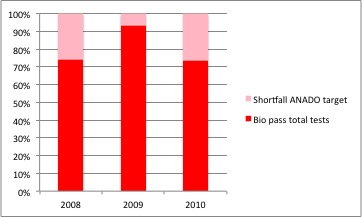
After my initial blog posts about the bio passport, there have been some interesting follow-ups from the UCI, Velocast, Cyclingnews and others. This is what the UCI data looks like for the total number of biological passport tests compared to what was originally suggested by Anne Gripper at the ANADO workshop:

Number of Biological Passport total tests vs "ANADO target"

So the achieved number of tests is 70-90% of the original target. Not great, but I’m willing to cut the UCI some slack as it is hard to predict at the start of a completely new project how things will progress and what is exactly needed.

However, it’s important to realize there are two types of tests in the biological passport; urine and blood. Each are used to detect different forms of doping, obviously the blood tests are pretty important to reveal various types of blood boosting).

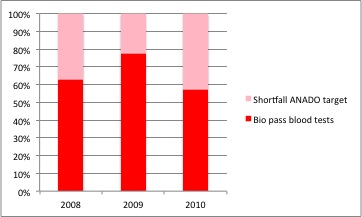
Urine and blood tests each have their individual targets, which for blood tests is 8720 tests per year (source: ANADO). The number of performed tests is lower (source: UCI). In a graph it looks like this:

Number of Biological Passport blood tests vs "ANADO target"

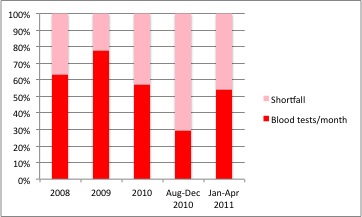
This shortfall is much more dramatic. But that’s not all. Remember that in the UCI’s response to my original “misleading, irresponsible, mischievous” blog, they provided data about the number of blood tests carried out. Let’s add that data to the chart, but before I do please note:

  • The data in their press release referred to broken years, so I calculated the tests per month to better compare. It’s not perfect as some periods may legitimately see a bit less testing than others, but that effect should be small as out-of-competition testing is a big part of the program.
  • The UCI provided numbers for July-Dec 2010 but excluding the Tour, so covering more than 5 but less than 6 months. I have calculated as if they cover 5 months, so the true Aug-Dec 2010 number is slightly worse than indicated in the graph.
Here we go, blood tests per month:
So in the Fall of 2010, blood tests were 70% below target. Now you can probably start to understand how riders told me they had not been tested for the bio passport. However, it’s good to see that the frequency is on the way up again, let’s hope that trend continues. Please let it be clear that I’m not here to slag the UCI, in fact I have posed a few questions to Enrico Carpani – the UCI spokes person – and he was gracious enough to answer them. I think it’s important to acknowledge the good sides of the UCI.

The UCI information will be part of the next installment (and it will show it’s a rather complex topic). I’m still waiting to write this next piece because although I understand 90% of what the UCI explained to me, I’m still waiting to get the last 10% answered as I prefer not to speculate. To not miss that next installment, you can subscribe here.

Female rider minimum wage – moral equality

October 6, 2011

We’ve looked at the practical possibilities of minimum wages for women in cycling, but how about the moral aspect. Should men and women have equal minimum wages in pro cycling? Sounds fair enough, doesn’t it? So it won’t surprised you that – unreasonable as I am – I’ll answer that with a big NO (and a small yes).

Let’s start with the small yes. I would agree that in their role as ATHLETES, they should be treated equally. If you get money just for being an athlete, you should get the same money regardless if you’re a male or female. For example, if you get money from your national olympic committee to prepare for London 2012 (as many athletes do), your gender shouldn’t matter.

In the same vain, it shouldn’t matter if you’re a rower, a ping pong player or a cyclist; if your country decides to spend tax dollars on sports in order to win medals at the olympics, it stands to reason you support all these athletes the same (if they pass the same criteria).

I don’t pretend to know all the Olympic programs in the world, but it is my impression that most national olympic committees work in this manner. Great, fantastic, equality achieved. But what the heck does this have to do with professional sports? I would argue: absolutely nothing.

Professional athletes aren’t paid to be athletes, they are paid in an economic transaction where the paying side receives a benefit that is hopefully bigger than the salary paid. The benefit could be in the form of direct revenue (ticket sales,merchandise) or indirect revenue (logo exposure or public appearances for a sponsor leading to a revenue increase for said sponsor). It has nothing to do with equality, it’s unequal in every way imaginable because it’s a simple economic transaction. A rower makes less money than a soccer player, a soccer player at Barcelona makes more than at Sporting Riga, per definition everybody gets compensated in line with the value they offer.

In some cases, a female athlete makes more than her male counterparts (I’m pretty sure the best-paid triathlete in the UK is a woman), unfortunately that’s rare. But in all cases, discussions about what people deserve are moot. Nobody deserves to be a professional athlete, there is no God-given right to turn your hobby into your job and get paid for it. It’s a privilege to find a company willing to support you to make that switch a reality. In fact, it’s also a privilege to have the tax payer support you to win some medals (or fail miserably) at the next olympics.

However, leaving it at that would be unfair to women sports. Although it is my strong belief that you cannot force sponsors to support athletes without an economic return (they will simply leave and sponsor golf or sailing instead), the same cannot be said for our sports federations.

We’ll cover that tomorrow, , so check back here or just subscribe.

Female rider minimum wage – UCI rules

October 5, 2011

Andrew P asked this question and I thought the answer warranted a new blog post:

Garmin Cervelo womens team were a UK registered team, no? UCI contract “suggests” that the team pay one of the following:

“This pay may not be less than the following amount:
(Choose one)
– The legal minimum wage of the country of the nationality of the UCI Team;
– The amount set by (name of NF) in its national regulations;
– The minimum wage negotiated by (name of NF) with (e.g. name of riders’ union) of the country”

Seems anomalous that GC team’s minimum wage rates set below the UK NMW limit.

For starters, I made a mistake in my write-up. So thanks for pointing that out, I have corrected it. The UK minimum wage when I calculated it last year came to 14,600 Euro, not 19,600 I have corrected the numbers in the blog now. It should also be noted that neo-pros are usually young, and different minimum wages apply to younger people in most countries (including the UK).

This also highlights another problem, which is exchange rates. The UCI rules reference the minimum wage of the registering federation (UK in our case) but obviously a rider living in Spain or the Netherlands wants to be paid in Euros, not GBP. And the team has no real choice in where to register, it is based on its roster (or it would have to hire some fake riders in a specific country, which is not unheard of).

Secondly, as Andrew indicated, the UCI nor most national federations mandate a minimum wage for women or continental riders, they merely “suggest” one. This is again different than for Pro Conti and WorldTour riders, where the minimum wage is mandatory.

Thirdly, even if the “suggestion” was enforced, not all riders on a continental or women’s team are considered “professional” by UCI rule standards. Article 2.17.004 states:

A continental or women’s team will comprise riders who may or may not be professional, in the elite and/or under 23 men’s categories for a continental team and elite women’s category for a wom- en’s team. It must have between 8 and 16 riders.

So you can have a continental or women’s team where nobody gets paid a salary. This is not necessarily a problem, if people want to race at that level, don’t want or need a salary, then they’re free to register and compete with other Continental teams and sometimes with Pro Conti teams. Most women riders do get paid, but the amount is below the minimum wage suggestion.

As it stands now, this is not a problem because it’s merely a suggestion, and even if it became mandatory, those women below the threshold would probably become “amateurs with some compensation”.

Fourthly, there are no definitions of full-time and part-time in the UCI rules. We compensate all riders on the basis of 12 months, and the analysis I showed before was based on what minimum wages look like for 40 hours onbut that doesn’t mean they are “locked-in” for those 12 months. Quite a few women riders study or work in parallel with their cycling career. Of course some do so because they have no choice given the salary they make riding, but for many it’s also a more cerebral choice.

For example, we have a rider who had a very good job at a major multinational before she focussed more on racing. She races the full season, but then in the Fall/Winter she has a few months to do projects for her old employer or some other companies. It keeps the door open for life after racing, and of course it supplements her income too. Similarly, we have a rider who is working on her PhD in the off-season.

Finally, which country applies? The UCI rules suggest to look at the country of registration, and certainly for the federation rules which need to be followed that makes sense. But for a legal discussion regarding minimum wage, it makes a lot less sense. For example, other than the registration at the British federation, Garmin-Cervelo has no ties with the UK. It’s not a UK company, virtually none of its races are there, virtually none of its riders live there.

In fact, for the national authorities (not the cycling authorities, but actual labor and tax authorities), the country of registration of the team is completely irrelevant. They look at where the employer and employee are based. If you are a UCI team registered in Spain and you pay a rider living in Switzerland a wage that is above the UCI minimum, above the Spanish minimum but below the Swiss minimum, you’ve got a problem (I’m simplifying a bit, it depends on self-employed vs employed, etc, but safe to say, it’s complicated).

Female rider minimum wage – compare to men

October 4, 2011

Men’s cycling has a minimum a minumum wage, but it’s a relatively recent phenomenon. Let’s take a look:

First off, there are several minimum wages for men. There is the minimum wage for riders of WorldTour teams (33,000 Euro), there is the minimum wage for Continental Pro teams (27,500 Euro) and then there are the Continental teams. For the latter, minimum wage is zero (which is probably one of the reason it’s zero for the women too, since many of the women’s regulations are based on Continental team rules).

On top of this, WorldTour and Pro Conti teams have separate minimum wages for neo-pros (26,700 and 23,000 Euro respectively). In case the rider is self-employed rather than directly employed by the paying agent, the minimum is 150% of the above (as the rider now has to pay his own social charges, etc).

If you make the minimum wage the same for women as it is for the WorldTour or Pro Conti, there would be no women’s teams left. It simply wouldn’t be viable at all, the disconnect between the exposure and the payroll would be completely out of whack. It’s already difficult – rightfully or wrongfully – to justify a women’s team for many organizations now. Doubling, trebling or tenfolding the payroll is not going to help the sport, it would kill it.

To put it bluntly, there are women’s teams with very small budget where the total payroll is about equal to the minimum wage of one WorldTour rider. And that’s not because the manager pockets all the money and is getting rich. Everybody on such teams is doing it for the love of the sport and happy to get a few Euros in compensation.

Therefore, to me asking for a minimum wage to be mandatory in women’s cycling is the backward approach. It won’t magically increase the budgets of the teams who currently can’t afford a minimum wage, it will simply shutter them. The only viable approach is to get the budgets up, and once they are up, you can start to set minimum wages. At that point it’s basically wealth redistribution, with the top rider salaries being blunted a little in favor of the domestiques.

But, you may argue, that’s an awfully practical approach. How about the principle that men and women riders should be treated equally? To see the sparks fly tomorrow, subscribe here.

Female rider minimum wage

October 3, 2011

Pat McQuaid was asked about a minimum wage for women riders, and said he didn’t think the sport had the level yet. Vos, Teutenberg, Bronzini and others took offense and were said to support the idea for a minimum wage. So this seems to be as good a time as any to delve into this issue.

As you may know, the Garmin-Cervelo women’s team has a minimum wage (and I believe it’s the only team to have one). The decision to do this was easy, the implementation not so easy. What should it be? With a  Dutch rider living in Spain riding for an American team registered in the UK, there’s no shortage of rates you can pick. And do you make it a true full-time wage that you can expect people to live off? Or is that simply not possible with the economics of women cycling? The countries that were most relevant to our team were as follows (using wikipedia and recalculating from International dollars to Euros):

  • UK: 14,600 Euro
  • Netherlands: 16,800 Euro
  • Spain: 9,000 Euro
  • USA: 13,000 Euro

As you can see, that’s quite a spread. To keep it easy, we went with 18,000 Euro (1500/mo) as the standard minimum wage on the team. We then made an exception for the minimum wage for neo-pros, which we put at 12,000 Euro (1000/mo). We felt this was necessary as a principle, to ensure fast flow through of young riders to the highest level. In men’s cycling, neo-pros also have a lower minimum salaries. And we figured that over time, we could raise the minimum wage level, while it would be hard to go the other way round.

It’s by no means a get-rich-quick scheme, but it’s a start and better than having riders race a whole season for free, as it still the case for about a quarter of the women’s peloton (this is a pretty rough estimate of questionable origin, but it sounds about right. If I were a journalist, I wouldn’t have mentioned it).

Tomorrow we’ll see how it all compares to the men, so if you don’t want to miss that, subscribe here.

NOTE Oct 5, 2011 – I corrected the UK minimum wage, I had typed 19,600 Euro, this should have been 14,600 Euro. Thanks to Andrew P for pointing out the error