Aggressiveness: Champions seem to be aggressive. Strong moves are indicative of the outstanding athlete. Yet the moves – whether made by design or by instinct – are not made frivolously but rather only at times when their chances can be greatly enhanced by such a maneuver.
Archive for the 'bike racing' Category
Trait 3 of champions
June 22, 2011Trait 2 of champions
June 20, 2011In Friday’s blog I mentioned the 11 traits of being a champion as used by Toby Stanton, which he sent me after my Vettel blog. Here’s the second trait on his list:
Self-Assured: Champions, the really great ones, never really boast. They have a quiet self-assuredness that transcends talk, and they seldom distract themselves with such foolishness.
I think my list of “really great champions” just shrunk. How about yours? Use the comments section or twitter to let me know.
11 Traits to being a champion
June 17, 2011Toby Stanton is the man behind the amazing Hottubes Junior development team (he simply gets on with the task of changing future cycling stars for the better rather than sit around and complain. Follow him @hottubes).
After I had posted “The Calm of Champions”, Toby sent me “11 Traits to being a champion”, a one-pager that he gives to every rider who joins his team. He hurried to tell me the original was not his, but he can’t remember whose it is. He did modify and update it to align it better with what he tries to teach his juniors. Here’s how it starts:
11 Traits to being a champion
1) Calmness: Champions demonstrate a stoic calmness that allows them to focus on the task at hand. No prima donna outbursts or ridiculous demands on friends or trainers. Just calm commitment.
As far as I know, Vettel never rode for Hottubes. I’ll post the other 10 in the next few weeks. Have a great weekend, and let me know your thoughts in the comments section below or via Twitter @gerardvroomen.
Toe-clips are better
May 24, 2011When I started writing about ignorance on Saturday, I actually wasn’t thinking of Versus TV. That just crept in. It was triggered by Sporza on Belgian TV.
You’d think that the commentating in one of the hotbeds of cycling would be excellent, and usually it is. I’ll even overlook the irresponsible rant that led to death-threats against Van Poppel during the 2009 Giro (Ah, the memories).
What really surprises me is the technophobia at Sporza. To this day, they maintain that alloy wheels with soldered spokes are the best for the cobbles and that carbon sucks, as is presumably putting a steak on your chamois for comfort. Never mind that alloy wheels haven’t won a major cobblestone classic in several years (not that this necessarily proves their superiority, but at least it shows they aren’t half-bad).
This past week they had an ex-rider speculate that Weylandt’s crash was caused by modern sunglasses and high-profile wheels. When I heard that, my ignoranometer went in the red:
- Why use such a tragedy to try and make a point?
- As tragic as it is, how can one crash prove anything? Cycling is a dangerous sport, and unfortunately it seems that every few years there is a fatality in the peloton. This was as true 100 years ago as it is today. Given how speeds have evolved without fatalities increasing, it seems that equipment is getting safer (first and foremost the helmet of course).
- The rider making these statements was from the era where everybody drilled holes in parts to make them lighter, so hardly a safety expert I would say.
- His argument on the sunglasses was that if you come out of a tunnel, you’re temporarily blinded. Is that because your sunglasses have to adjust, or your eyes?
- He “boosted” his argument by saying that in his day, riders would avoid riding behind someone with glasses, especially in the rain. How is that friggin related? Of course you stay away from a guy who can’t see anything in the rain, and I doubt they were wearing sunglasses.
- The high wheels argument has some merit in the sense that they can be more sensitive in wide winds. However, the concept that such wheels are stiffer in the vertical plane and therefore offer less grip has been disproven so many times (they are not stiffer because vertical stiffness is all driven by the tire and the spokes, not the rim).
What’s next? Back to the Danish helmet, drill out your seatpost, and toe-clips are safer?
Xavier
May 23, 2011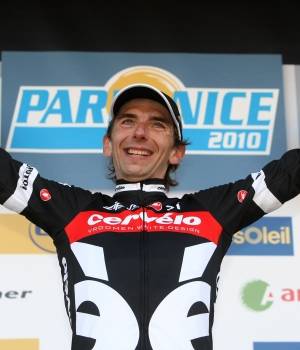 My music shuffle had just reached Israel Kamakawiwo’ole’s “Somewhere over the rainbow” when the SMSs and Tweets came in. Xavier Tondo is dead. Im sitting here behind my computer, close to tears for a man I didn’t even know that well.
He rode for the TestTeam for just one year, in 2010. I met him only a half dozen times, but he was special. I never saw him upset or angry, he was always smiling, always friendly, not a bad bone in his body. For years and years he tried to break into the big league, but he was somehow always overlooked. Whatever the reason, it hadn’t seemed to affect him. He loved cycling – anywhere, anytime, in any race and with anyone – and was simply happy that in 2010, he finally got his chance. And he took that chance.
Although there are no locker rooms in cycling, you’d want to build one and introduce a half-time in cycling just so he could be that guy who makes a difference for the second half. It’s important to have a few stars, but it’s even more important to have some guys who keep it all together. Xavier was the glue.
Now my shuffle is playing “Comptine d’un autre été – L’après-midi” from Yann Tiersen, how appropriate.
My favorite memory of Xavier comes from after the TestTeam stopped. He got a contract at Movistar, finally the big Spanish team recognized him for what he was, one of the biggest raw talents despite his age. In November, we held our annual dealer meetings in Portugal, and we were looking for some riders to take our dealers for a spin.
Although there was no reason left to do anything for us, and several riders indeed refused to show up when asked, Xavier was there, smile in tow. He hung out with our dealers, went with them on beautiful rides and afterwards, all these German, Belgian and Dutch dealers had suddenly become fans of a Spanish rider.
The shuffle switches to Pink, that doesn’t work. Better write in silence now.
I particularly remember one ride where he hammered for four hours with our strongest dealers in his slipstream, riding at their max and loving every second of it. Upon their return, the heart-rate monitors revealed a sufferfest of epic proportions. Then one dealer made the unwise decision to check Xavier’s monitor. Average 96 bpm!
A big heart in more ways than one. RIP.
Ignorance
May 21, 2011I have a low tolerance for ignorance. Or more accurately, for ignorant people who should know better.
Which is why, when I lived in Canada, I used to hate listening to the cycling commentary. Four guys at the table, some knowledgeable, some completely clueless, with the result that the only safe topic was Lance (because to have an opinion on him, they didn’t need to follow cycling, reading People magazine was sufficient).
With the Ride of the Day (brought to you by Bowflex, the machine of choice for a 50-year-old grandma and a dude who can’t keep his shirt on) guaranteed to be Lance and the Team of the Week (brought to you by a guy who eats at Subways and still wears pants that are 30 sizes too large) always US Postal, any clown can present the show – and boy did they hire some over the years.
The excuse was always they used clowns so clueless viewers had someone to identify with, but don’t the viewers deserve a bit more respect than that?
Now that the Tour of California is going on, I was wondering: How is the commentating now on VS? Has it improved? Let me know in the comments section.
Update: Roger that!
May 4, 2011As you probably remember, what should have been Roger Hammond’s season highlight – Paris-Roubaix – ended in a hospital bed. He sent me this update and allowed me to share it with you (Roger’s wife works in a hospital, so you’ll notice Roger takes particular interest in that area!):
Just a quick update…
The good news… I’m finally starting to heal now. The stitches are out and I have to say the hospital in Valenciennes did a great job, quite a neat scar when you take into consideration what they started with. And no sign of infection. Although I was on a huge dose of antibiotics for 8 days just in case. The reason for such a high dose, they weren’t taking any risks. They let me know just before they took me to surgery, they’d had a rider in about 8 years ago that had a really nasty infection after crashing in Arenberg. I guess they were trying to make me feel better about the impending surgery!
The bad news is I still have a lot of pain in the elbow joint itself and it is still swollen. I’ve been waiting for improvement but it is a lot slower than anticipated. I’m starting to get impatient so I’m going to see Matt (team chiro) to get his opinion on how best to treat the injury. I subsequently found I had broken a rib in the crash too, which just added to the sleeping difficulties!
Fabian’s Flipside
April 17, 2011Another Spring classic, another thought on Fabian. Let’s face it, he is the man around whom all the Classics revolve so far. With his decision to participate in the Amstel Gold Race, will this one be any different?
There are actually two BIG differences. First off, he’s not the favorite, Gilbert is. Secondly, he’s on arguably the strongest team in this race, not one of the weaker ones.
What isn’t so different from last week, ironically, is the type of race. Sure, Roubaix is flat as a pancake with horrible roads while Amstel has 3,000 little climbs and the world’s largest collection of road furniture (when did that stop being called speed bumps and road signs?). But for a rider like Cancellara, that hardly matters as he excels in both (witness his performance on the Poggio and the Leberg).
More importantly, Amstel and Roubaix are the two races most prone to the dozen little groups scenario, almost every year these races explode in small fractions and the accompanying tactical chess game of who’ll rides and who won’t. Which in turn means it’s all about the numbers. If Cancellara jumps away alone or in a small group, who will chase him down with one or both Schlecks (likely one as the other will invariably crash in Amstel) on their wheel? My guess would be that eventually, nobody will fully commit, and instead the chase will shrivel in self-pity and frustration. Not unlike Roubaix of course.
The only question mark over such a scenario is Fabian himself. He was strong all the way back at Milan-SanRemo, is it possible to still be strong today? Or is the candle burnt up after E3, Flanders and Roubaix? Boom or Bust, not much in the middle.
The horse is dead, long live the horse
April 14, 2011It seems to me the Paris-Roubaix tactics horse shows extremely weak signs of life, but I keep getting questions and I don’t want to be so rude not to answer them. Therefore, one last round (and most of the questions have some novelty to them). So, Dominic asked:
Let’s say there are no race radios and the same situation would have happened with JVS at the front, Thor and Fabian in the second or third group with 40 km to go. Fabian would have probably attack and Thor would have followed because he couldn’t be 100% sure that is teamate was really at the front. He would have attacked with Fabian and that would have been the best thing to do because strategy would be less important without earbuds. At least, harder to put in place. What would have happen then? The best rider would have won. Fabian or Thor, nobody knows!
First of all, Thor WOULD know that JVS is in the front, in fact Garmin-Cervelo has ridden every classic as if there are no radios. Just study the tapes, you will see that they are always close to each other when it matters. It makes a ton of sense if there is a mechanical (as Boonen can attest to) and for tactical reasons. So in that sense, the tactics are the same. JVS would ride in the front saying he doesn’t have to work because Thor is behind, and Thor would not have to work because JVS is in the front. Racing has been like this since long before radios, this is not some new tactical invention. Then Jpmikkelsen asks:
I did not understand why Sep Vanmarcke had to help Fabian at some point. Why did you guys do that?
Jonathan Vaughters answered that to Podiumcafe: “We wanted the gap to be tight (40secs) so the others in the break were forced to work hard. And… so that Fabs [would] think he could get across towing Thor. A big gap (2mins), the break starts to look at each other, and [Fabian Cancellara] gives up.”
It all comes down to that Hennie Kuiper quote (you know, the guy who raced before there were radios), about finishing everybody else’s plate before you start your own. And the thing is, for the people who claim that Cancellara was the strongest and that Thor should have helped him, I still haven’t heard a single tactical scenario where helping Cancellara leads to Thor winning.
Sprinter vs. Rouleur
April 13, 2011Well, that Paris-Roubaix certainly unleashed some emotions. Some are upset with Thor for not working with Cancellara. Five things on that:
- Thor had his teammates Sep Vanmarcke and Gabriel Rasch work to narrow the gap on the front group. Why didn’t Cancellara have his teammates help? Oh that’s right, they weren’t there. It’s not Thor’s fault that Cancellara moved to Leopard, he had offers from Sky and BMC, both of which have strong classics teams.
- When the gap wasn’t closed, should Thor do the work himself to close down the gap? I think it has been the case for 100 years that if you have a sprinter and a rouleur, the rouleur needs to try and drop the sprinter before they get to the finish. Remember Paris-Roubaix with Van Steenbergen and Coppi out in front? Van Steenbergen won the sprint (expectedly) but said afterwards: “If Fausto had jumped one more time, I would have had to let him go, I was done.” To which Coppi replied: “If I had been able to jump once more, I would have.”
- It seems Cancellara and l’Equipe feel that Thor should pull Cancellara to the front group and waste his energy so that Cancellara can then jump away from him. Only a dumb rider would do that, and Thor ain’t dumb.
- If Cancellara was really that strong, he would have dropped Thor on the cobbles. He didn’t, in fact Thor followed with relative ease. Now he dropped him on the final drag. Thor was caught out of position there and made Flecha try to close the gap first, who couldn’t. Could Thor have? If he had been in position, maybe.
- In the end, Cancellara can complain all he wants but he himself chose his team, he chose to show off his strength at E3 and make himself the absolute top favorite. Despite that, the other teams basically handed him the win in Flanders with their early-race tactics but he over-estimated his strength in trying a 50k breakaway. In Roubaix, I don’t think he was on Superman form and combined with being outnumbered it was going to be very difficult in any scenario. I can understand that he is frustrated for being the strongest rider in the Spring and not winning any of the big races, but he can’t complain that his competitors didn’t help him. Last time I checked that’s not their job. Maybe he’ll do Amstel and/or LBL and win there.
 gerard.cc