Bio passport redux

October 7, 2011

Note: if you don’t want to read the whole article, scroll down to the last graph.

After my initial blog posts about the bio passport, there have been some interesting follow-ups from the UCI, Velocast, Cyclingnews and others. This is what the UCI data looks like for the total number of biological passport tests compared to what was originally suggested by Anne Gripper at the ANADO workshop:
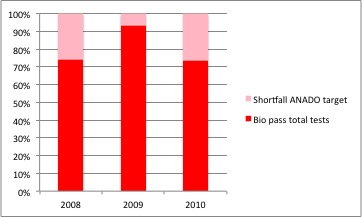
Number of Biological Passport total tests vs "ANADO target"

So the achieved number of tests is 70-90% of the original target. Not great, but I’m willing to cut the UCI some slack as it is hard to predict at the start of a completely new project how things will progress and what is exactly needed.

However, it’s important to realize there are two types of tests in the biological passport; urine and blood. Each are used to detect different forms of doping, obviously the blood tests are pretty important to reveal various types of blood boosting).

Urine and blood tests each have their individual targets, which for blood tests is 8720 tests per year (source: ANADO). The number of performed tests is lower (source: UCI). In a graph it looks like this:
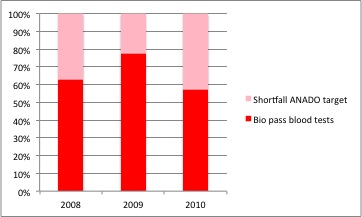
Number of Biological Passport blood tests vs "ANADO target"

This shortfall is much more dramatic. But that’s not all. Remember that in the UCI’s response to my original “misleading, irresponsible, mischievous” blog, they provided data about the number of blood tests carried out. Let’s add that data to the chart, but before I do please note:

  • The data in their press release referred to broken years, so I calculated the tests per month to better compare. It’s not perfect as some periods may legitimately see a bit less testing than others, but that effect should be small as out-of-competition testing is a big part of the program.
  • The UCI provided numbers for July-Dec 2010 but excluding the Tour, so covering more than 5 but less than 6 months. I have calculated as if they cover 5 months, so the true Aug-Dec 2010 number is slightly worse than indicated in the graph.
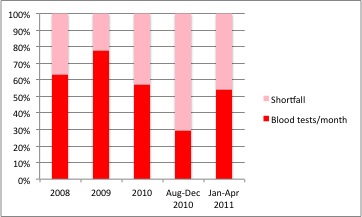
Here we go, blood tests per month:
So in the Fall of 2010, blood tests were 70% below target. Now you can probably start to understand how riders told me they had not been tested for the bio passport. However, it’s good to see that the frequency is on the way up again, let’s hope that trend continues. Please let it be clear that I’m not here to slag the UCI, in fact I have posed a few questions to Enrico Carpani – the UCI spokes person – and he was gracious enough to answer them. I think it’s important to acknowledge the good sides of the UCI.

The UCI information will be part of the next installment (and it will show it’s a rather complex topic). I’m still waiting to write this next piece because although I understand 90% of what the UCI explained to me, I’m still waiting to get the last 10% answered as I prefer not to speculate. To not miss that next installment, you can subscribe here.


Female rider minimum wage – moral equality

October 6, 2011

We’ve looked at the practical possibilities of minimum wages for women in cycling, but how about the moral aspect. Should men and women have equal minimum wages in pro cycling? Sounds fair enough, doesn’t it? So it won’t surprised you that – unreasonable as I am – I’ll answer that with a big NO (and a small yes).

Let’s start with the small yes. I would agree that in their role as ATHLETES, they should be treated equally. If you get money just for being an athlete, you should get the same money regardless if you’re a male or female. For example, if you get money from your national olympic committee to prepare for London 2012 (as many athletes do), your gender shouldn’t matter.

In the same vain, it shouldn’t matter if you’re a rower, a ping pong player or a cyclist; if your country decides to spend tax dollars on sports in order to win medals at the olympics, it stands to reason you support all these athletes the same (if they pass the same criteria).

I don’t pretend to know all the Olympic programs in the world, but it is my impression that most national olympic committees work in this manner. Great, fantastic, equality achieved. But what the heck does this have to do with professional sports? I would argue: absolutely nothing.

Professional athletes aren’t paid to be athletes, they are paid in an economic transaction where the paying side receives a benefit that is hopefully bigger than the salary paid. The benefit could be in the form of direct revenue (ticket sales,merchandise) or indirect revenue (logo exposure or public appearances for a sponsor leading to a revenue increase for said sponsor). It has nothing to do with equality, it’s unequal in every way imaginable because it’s a simple economic transaction. A rower makes less money than a soccer player, a soccer player at Barcelona makes more than at Sporting Riga, per definition everybody gets compensated in line with the value they offer.

In some cases, a female athlete makes more than her male counterparts (I’m pretty sure the best-paid triathlete in the UK is a woman), unfortunately that’s rare. But in all cases, discussions about what people deserve are moot. Nobody deserves to be a professional athlete, there is no God-given right to turn your hobby into your job and get paid for it. It’s a privilege to find a company willing to support you to make that switch a reality. In fact, it’s also a privilege to have the tax payer support you to win some medals (or fail miserably) at the next olympics.

However, leaving it at that would be unfair to women sports. Although it is my strong belief that you cannot force sponsors to support athletes without an economic return (they will simply leave and sponsor golf or sailing instead), the same cannot be said for our sports federations.

We’ll cover that tomorrow, , so check back here or just subscribe.


Female rider minimum wage – UCI rules

October 5, 2011

Andrew P asked this question and I thought the answer warranted a new blog post:

Garmin Cervelo womens team were a UK registered team, no? UCI contract “suggests” that the team pay one of the following:

“This pay may not be less than the following amount:
(Choose one)
– The legal minimum wage of the country of the nationality of the UCI Team;
– The amount set by (name of NF) in its national regulations;
– The minimum wage negotiated by (name of NF) with (e.g. name of riders’ union) of the country”

Seems anomalous that GC team’s minimum wage rates set below the UK NMW limit.

For starters, I made a mistake in my write-up. So thanks for pointing that out, I have corrected it. The UK minimum wage when I calculated it last year came to 14,600 Euro, not 19,600 I have corrected the numbers in the blog now. It should also be noted that neo-pros are usually young, and different minimum wages apply to younger people in most countries (including the UK).

This also highlights another problem, which is exchange rates. The UCI rules reference the minimum wage of the registering federation (UK in our case) but obviously a rider living in Spain or the Netherlands wants to be paid in Euros, not GBP. And the team has no real choice in where to register, it is based on its roster (or it would have to hire some fake riders in a specific country, which is not unheard of).

Secondly, as Andrew indicated, the UCI nor most national federations mandate a minimum wage for women or continental riders, they merely “suggest” one. This is again different than for Pro Conti and WorldTour riders, where the minimum wage is mandatory.

Thirdly, even if the “suggestion” was enforced, not all riders on a continental or women’s team are considered “professional” by UCI rule standards. Article 2.17.004 states:

A continental or women’s team will comprise riders who may or may not be professional, in the elite and/or under 23 men’s categories for a continental team and elite women’s category for a wom- en’s team. It must have between 8 and 16 riders.

So you can have a continental or women’s team where nobody gets paid a salary. This is not necessarily a problem, if people want to race at that level, don’t want or need a salary, then they’re free to register and compete with other Continental teams and sometimes with Pro Conti teams. Most women riders do get paid, but the amount is below the minimum wage suggestion.

As it stands now, this is not a problem because it’s merely a suggestion, and even if it became mandatory, those women below the threshold would probably become “amateurs with some compensation”.

Fourthly, there are no definitions of full-time and part-time in the UCI rules. We compensate all riders on the basis of 12 months, and the analysis I showed before was based on what minimum wages look like for 40 hours onbut that doesn’t mean they are “locked-in” for those 12 months. Quite a few women riders study or work in parallel with their cycling career. Of course some do so because they have no choice given the salary they make riding, but for many it’s also a more cerebral choice.

For example, we have a rider who had a very good job at a major multinational before she focussed more on racing. She races the full season, but then in the Fall/Winter she has a few months to do projects for her old employer or some other companies. It keeps the door open for life after racing, and of course it supplements her income too. Similarly, we have a rider who is working on her PhD in the off-season.

Finally, which country applies? The UCI rules suggest to look at the country of registration, and certainly for the federation rules which need to be followed that makes sense. But for a legal discussion regarding minimum wage, it makes a lot less sense. For example, other than the registration at the British federation, Garmin-Cervelo has no ties with the UK. It’s not a UK company, virtually none of its races are there, virtually none of its riders live there.

In fact, for the national authorities (not the cycling authorities, but actual labor and tax authorities), the country of registration of the team is completely irrelevant. They look at where the employer and employee are based. If you are a UCI team registered in Spain and you pay a rider living in Switzerland a wage that is above the UCI minimum, above the Spanish minimum but below the Swiss minimum, you’ve got a problem (I’m simplifying a bit, it depends on self-employed vs employed, etc, but safe to say, it’s complicated).


Female rider minimum wage – compare to men

October 4, 2011

Men’s cycling has a minimum a minumum wage, but it’s a relatively recent phenomenon. Let’s take a look:

First off, there are several minimum wages for men. There is the minimum wage for riders of WorldTour teams (33,000 Euro), there is the minimum wage for Continental Pro teams (27,500 Euro) and then there are the Continental teams. For the latter, minimum wage is zero (which is probably one of the reason it’s zero for the women too, since many of the women’s regulations are based on Continental team rules).

On top of this, WorldTour and Pro Conti teams have separate minimum wages for neo-pros (26,700 and 23,000 Euro respectively). In case the rider is self-employed rather than directly employed by the paying agent, the minimum is 150% of the above (as the rider now has to pay his own social charges, etc).

If you make the minimum wage the same for women as it is for the WorldTour or Pro Conti, there would be no women’s teams left. It simply wouldn’t be viable at all, the disconnect between the exposure and the payroll would be completely out of whack. It’s already difficult – rightfully or wrongfully – to justify a women’s team for many organizations now. Doubling, trebling or tenfolding the payroll is not going to help the sport, it would kill it.

To put it bluntly, there are women’s teams with very small budget where the total payroll is about equal to the minimum wage of one WorldTour rider. And that’s not because the manager pockets all the money and is getting rich. Everybody on such teams is doing it for the love of the sport and happy to get a few Euros in compensation.

Therefore, to me asking for a minimum wage to be mandatory in women’s cycling is the backward approach. It won’t magically increase the budgets of the teams who currently can’t afford a minimum wage, it will simply shutter them. The only viable approach is to get the budgets up, and once they are up, you can start to set minimum wages. At that point it’s basically wealth redistribution, with the top rider salaries being blunted a little in favor of the domestiques.

But, you may argue, that’s an awfully practical approach. How about the principle that men and women riders should be treated equally? To see the sparks fly tomorrow, subscribe here.


Female rider minimum wage

October 3, 2011

Pat McQuaid was asked about a minimum wage for women riders, and said he didn’t think the sport had the level yet. Vos, Teutenberg, Bronzini and others took offense and were said to support the idea for a minimum wage. So this seems to be as good a time as any to delve into this issue.

As you may know, the Garmin-Cervelo women’s team has a minimum wage (and I believe it’s the only team to have one). The decision to do this was easy, the implementation not so easy. What should it be? With a  Dutch rider living in Spain riding for an American team registered in the UK, there’s no shortage of rates you can pick. And do you make it a true full-time wage that you can expect people to live off? Or is that simply not possible with the economics of women cycling? The countries that were most relevant to our team were as follows (using wikipedia and recalculating from International dollars to Euros):

  • UK: 14,600 Euro
  • Netherlands: 16,800 Euro
  • Spain: 9,000 Euro
  • USA: 13,000 Euro

As you can see, that’s quite a spread. To keep it easy, we went with 18,000 Euro (1500/mo) as the standard minimum wage on the team. We then made an exception for the minimum wage for neo-pros, which we put at 12,000 Euro (1000/mo). We felt this was necessary as a principle, to ensure fast flow through of young riders to the highest level. In men’s cycling, neo-pros also have a lower minimum salaries. And we figured that over time, we could raise the minimum wage level, while it would be hard to go the other way round.

It’s by no means a get-rich-quick scheme, but it’s a start and better than having riders race a whole season for free, as it still the case for about a quarter of the women’s peloton (this is a pretty rough estimate of questionable origin, but it sounds about right. If I were a journalist, I wouldn’t have mentioned it).

Tomorrow we’ll see how it all compares to the men, so if you don’t want to miss that, subscribe here.

NOTE Oct 5, 2011 – I corrected the UK minimum wage, I had typed 19,600 Euro, this should have been 14,600 Euro. Thanks to Andrew P for pointing out the error


Most cyclists are losers

September 30, 2011

99.5% to be pseudo-scientific. 200 riders line up, 199 lose. If you’re lucky, your teammate wins and you feel like a winner too, leaving only 191 losers. Still, that’s not a good ratio.

But it gets worse. The course has certain characteristics. Often those characteristics suit a particular type of rider, and often you’re not that type. Now you’re chances of escaping loserville become very slim indeed. In other words, you know that if this race follows the standard “bike race script”, you’ll be nothing more than field-filler.

What’s the logical conclusion? In my view there could be three:

  1. Have a teammate with an above-average chance of winning
  2. Stay in bed
  3. Hatch a clever plan

The clever plan isn’t really that complicated. If following the script leads to guaranteed loserdom, you need to disrupt the script. Don’t follow the standard plan, create chaos. The race will still have only one winner, but in the chaos, the chances of the real contenders diminish. In fact, your chances increase not just because theirs are reduced, but also because as the instigator of the chaos, you have an analytical and psychological head-start.

This applies to any race, but to none more so than races predicted to end in sprints such as the World Championships this year. It wasn’t so hard to predict the winners of the women’s and men’s race this weekend in case of a bunch sprint (even I managed to name Cavendish and Bronzini as the fast-twitch-champs). If there ever was a race that called for chaos, this was it. And with most teams having multiple captains, the opportunities were enormous.

Too bad everybody followed the script. Therefore, Bronzini and Cavendish are worthy champions. They made the most of the circumstances which were known to all. Maybe the course wasn’t worthy, maybe some competitors weren’t worthy, but they are.

What do you think of the tactics you see in general in cycling? Impressive or snooze? Let me know via the comments section below. Next week we’ll talk about minimum wages for women riders and about the fall-out from the new UCI points ranking, if you don’t want to miss that you can subscribe here.


Cycling’s next controversy?

September 29, 2011

Tim DeWaele was the first to publish photos of Mark Cavendish in his HTC rainbow jersey (more of Tim’s Cavendish photos here):

This jersey appears to violate the UCI regulations regarding the rainbow jersey in at least seven areas:

  • The advertising on the front and back of the jersey has to fit in a box 10cm high (with the exception of the apparel manufacturer’s logo, MOA in this case). Obviously the Specialized S does not fit in a 10cm high box together with Highroad.
  • The Lezyne logo at the bottom is not allowed. Maybe he can tuck in his jersey inside his bibs, that would solve this particular problem (though maybe not entirely “pro”).
  • Logos on the side of the jersey are not allowed
  • Logo on the chest should be UCI logo, not WorldTour logo
  • UCI logo should be on the right chest, not the left
  • The logos on the rainbow stripes on the collar must be the UCI logos, not the sponsor logos.
  • The rainbow stripes on the sleeves need to be at least 35mm from the edge of the sleeve. I never understood this rule, in the old days the rainbow stripes WERE the edge of the jersey and that looked way nicer, but I digress.

Before you even produce a jersey, you need to submit it for approval to the UCI. So what happened here? Did the UCI approve a jersey that completely violates their rules, did MOA produce without submitting the design, did they make this one for the sponsors without intention to race in it?

The latter wouldn’t necessarily get them off the hook because the UCI claims to own the rainbow stripes, so making anything with those requires their permission. I have to add, the UCI has been very weak in defending their design for years (witness the rainbow as part of the Colnago logo and the Ritchey WCS series for example).

In fact, even approval from the UCI doesn’t explicitly get you off the hook. The rules state that a fine is due if the sponsor logo dimensions don’t meet the requirements, they do not state that a design approval frees you from that threat. Of course you’d have a pretty strong case, but still.

We’ll see where this goes. And don’t think we’re talking chump change here. The MINIMUM fine for producing an incorrect rainbow jersey is CHF 10,000 per event!


How self-confidence loses races

September 28, 2011

I alluded to this in my pre-Worlds write-up, but I was so amazed at how the race unfolded that I want to bring it up again.

First off, the Brits rode an incredible race and when Cavendish ended up in a lost position with 250m to go, he found the tiniest of gaps, went through it and became the deserving champion. They rode a great race, so did Ben King and the Belgiums. Unfortunately it’s tough to call it a great race when the other teams never participated, let’s say it was a great team time trial (maybe the other teams were confused because the team time trial is only a world championships event starting NEXT year).

Were the Brits so good that they kept the tempo high enough for 260k so that nobody could escape? I’ll stick with my original statement that that is impossible. If every rider spends 35k in the front, there is no way they can keep a tempo that prevents people from jumping away. Obviously they got some help from the Germans (and from Ben King) and they were able to take their rest during stretches where the pace “slowed”, enough so that in the last 60k they could dictate a blistering pace. Still very impressive, but why did the other teams allow that to happen?

Psychology.

For starters we have the first breakaway. Somehow when the first break of non-contenders is up the road, everybody follows the “group up the road” script. They grow their lead, it hovers around 5-8-10-15 minutes (whatever makes sense on that course), then their lead dwindles and when they’re almost caught the next adventurers try their luck. But the “group up the road” script gave the Brits a chance to conserve energy as the pace dropped, energy they put to good use in the last lap.

To their credit, the Belgians were the only ones who realized that the “group up the road” script – while standard – would not work be the best script for them and they sent two riders in a second group long before the first group was caught. But both groups were too small to really develop a pace that could rival the British time trial machine, so they never had to go too deep to stay within reach.

The second bit of psychology is the self-confidence abundantly present in sprinters. Ten riders fancy themselves bunch sprinters, and all ten figured they could win on Sunday. It doesn’t matter how often they’ve been beaten by Cavendish, because the selection process from 10 year-old boy to top sprinter ensures that all ten are convinced of their own capabilities. And so any glimmer of hope is used to convince oneself that Copenhagen will be different than the dozen recent losses they may have suffered against Cavendish.

And going forward, the same will continue. Goss will tell himself that if he had kept Haussler’s wheel, he would have won. Greipel will convince himself that with a better position, next year’s rainbow jersey would be XXL instead of XXS. Heck, Cancellara may have read yesterday’s blog comments and realize he would have won had he been in his drops or chopped them off!

Of course, none of this is true. Football used to be a game in which 11 play 11 with a round ball for 90 minutes and in the end, the Germans win. Likewise, flat courses give us races of 200 cyclists where 10 fancy their chances and in the end, Cavendish wins.

P.S. If Cavendish flats or he doesn’t find the gap, obviously this whole theory goes down the drain. But the reality is, he did find the gap and he rarely flats.

To receive my blog posts automatically, you can subscribe here.


World Championship bar height

September 27, 2011

Earlier this year I spoke about bike set-up, and how handlebars are being placed lower and lower these past half century. Of course evolution doesn’t go that fast, riders today are no more flexible than Merckx was. Rather than “regular” riders trying to get as low as some of today’s pros, it would be better for pros to go higher (like Merckx, not exactly a chopper in his hayday, was he)?

Of course this topic always leads to all sorts of macho nonsense like “slam that stem” and other (sometimes tongue-in-cheek) efforts to look “pro” when you’re not and remove any pleasure from riding a bike. This is not to say that a low position doesn’t work for some, only that people should look for their correct position, not their lowest position, and that in many cases – pro and “regular” – that correct position is higher than people often try to squeeze themselves into.

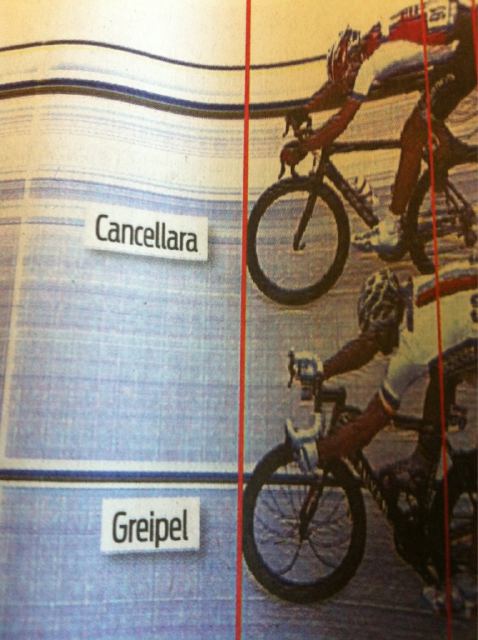
Recently, somebody commented that apparently I know Cancellara’s position is wrong and somebody should tell him. But it’s not a matter of his position being right or wrong, it’s about the bars being so low you lose the benefit of the drops. If a rider puts his hoods where his lowest comfortable and aero position is, then why not have flat bars?

Don’t take my word for it, just look at the photo and tell me if you see anything odd:

Fairly unorthodox sprint for Cancellara


World Championships men’s race

September 23, 2011

Yesterday we looked at the women’s race, now let’s look on the other side of the gender-fence.

First of all, what type of race will this be? Yes, the course is flat, and the level in men’s racing is very even, at least among the top 15 countries. Sounds like a recipe for a mass sprint, doesn’t it? I’m not so sure.

The problem is, if the whole groups stays together, Mark Cavendish wins the sprint. Maybe not every time, but at least 11 times out of 10. That logically means there is one team that should want a mass sprint, and the rest of the world doesn’t. And one team, even if it has Wiggins, Millar and Thomas, cannot keep a bunch together for 266km.

Of course, there’s one mechanism that can help Cavendish. You see, one of the attributes you must possess to become a pro cyclist is a huge belief in yourself, so even those with no chance whatsoever in a mass sprint will think they have a chance in a mass sprint. Even team managers con themselves into such thoughts – witness the 10 teams waiting for the final sprint on the Champs Elysees after being royally beaten by Cav on four previous stages.

Lets assume that sanity will prevail, and that all teams but one will work to break up the group. Which riders have a nose for the right group and can win a sprint when a few of the top sprinters are missing? Hushovd and Gilbert.

Much has been made of Hushovd’s non-selection for the Vuelta. The comments that followed were quite unfair I think (if you want I can write about that some other time), but the point for this race is that IT DOES NOT MATTER. As I saw in 2009 and 2010 at the Cervelo TestTeam, if Thor puts an X on his calendar, he is ready on that date. He can prepare in the Vuelta, the Tour of Britain, at home or in your local spinning class, it does not matter. Thor will be ready, and a ready and focused Thor can win anything. If Edvald Boasson Hagen is on form too, the Norwegians will have a formidable 1-2 punch that will be tough to control if the field is thinned out sufficiently.

In a way, Gilbert is a lot like Hushovd. Both have a great focus and a great sprint especially on slightly rising roads, although Gilbert seems to have a longer jump in him and get stronger as the road gets steeper. It’s tough to say how Copenhagen would work out, the finish is definitely uphill but not quite tailor-made for Gilbert (I should say that it is made for Gilbert but it’s at an incline that other sprinters on-form can also master, if it was 3% steeper Gilbert would be in a class of his own with no competition).

In a sense this race has a few levels. When the group is complete, only Great Britain and maybe the US (for Farrar) will try to keep it together. If it breaks up in smaller bits and Gilbert and Hushovd are in front, more countries will fancy their chances in a sprint against those two, especially if the Aussies have the right people up-front. That means there is a better chance of such a group making it to the finish. If the group on the front becomes too small, too many behind have their own agenda and it will come back together.

Logically that means a first escape of non-contenders will go early, followed by a contendor group bridging up in the later stages. If that contender group has to work hard to stay ahead of for example Cavendish, Gilbert and others who fancy a sprint will need to use up their domestiques, opening up the possibilities for a small group to jump clear in the last few laps. And who knows, out of that may even come a last-lap solo effort, the tactics at Worlds usually become so complicated that riders turn into on-course spectators who forget to pedal.

That’s what makes the World Championships the best race of the season. National teams, trade team ties and the ultimate skill of “finishing everybody else’s plate before starting your own” means that even with a boring course, the race can prove anything but. Especially when the weather turns foul.