Not afraid to fail: To a degree, we are all afraid to fail. The champion seems to be willing to risk it in spite of the possibility of catastrophe.
Trait 5 of champions
July 28, 20112 points on arm position in cycling – #2
July 27, 2011The second point on arm position comes from Gabriel Rasch. He is the inventor of the Gabba jacket that Castelli developed with the Cervelo TestTeam, a tight-fitting aero rain jacket that works best in the worst conditions. I hear it will be sold in stores in the future too.
Gabriel has the most amazing position on the bike that I have ever seen. I noticed this at the first ever training camp of the Cervelo TestTeam. We went on a ride with sponsors, media, etc and on the way back to the hotel we were riding side-by-side for a long stretch (The only thing I remember more than Gabba’s arms was that the ride ended with a sprint where Gabba dragged me to the front group, at which point I misunderstood his intentions. He slowed down because he knew where the line was, I didn’t so I passed him to circle through and was surprised nobody took over from there. When finally somebody did pass me, it was Thor in full sprint. Suffice to say I was unable to catch that wheel. He never thanked me for the lead-out).
Anyway, the brilliance of Gabba’s position is in his arms. When he rides on the hoods or in the drops, his elbows don’t stick out to the sides at all, his forearms come straight back from the handlebars and straight down from the shoulder (nitpicking trigonometrists will now point out that this would require the bars to be the width of the shoulders, as per the myth I ridiculed in an earlier blog). In fact he twists his elbows inwards. He is not aware of it being anything special, it’s just what his arms do naturally, but try it on your next ride and see what happens when you twist those elbows inward.
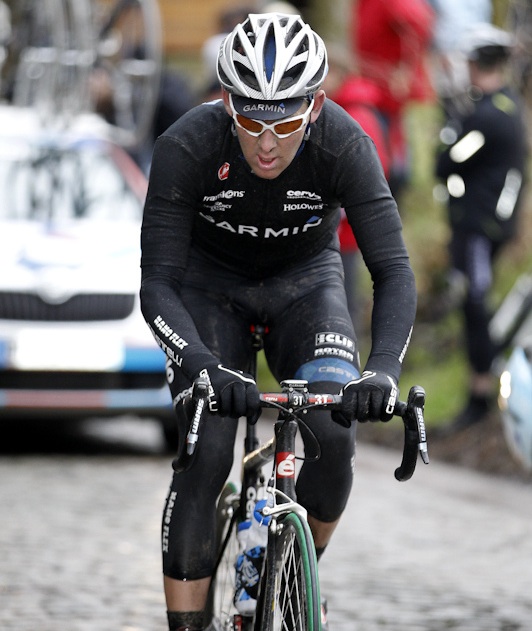
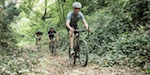
Not a great example of Gabba's position as he is not on the hoods or in the drops, but a nice shot of the Gabba rain jersey/jacket
2 points on arm position in cycling – #1
July 26, 2011The first point on arm position I got from Henk Lubberding, a famous Dutch rider from the Ti-Raleigh/Panasonic period. I was a guest together with him once in “De Avondetappe”, a Dutch daily talkshow about the Tour de France. Great guy, great thinker on cycling (he has this clever technique he calls “Breaking with ABS on a bike”) and the topic of arm position also came up.
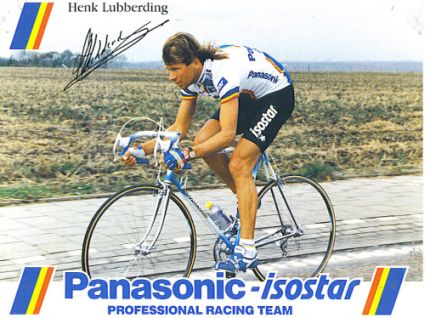
Henk Lubberding in his Panasonic time.
What he observes a lot (and so do I since he pointed it out) is that people ride with their arms stretched out. Especially in the drops, this happens a lot. The main reason is that people (including pros) put their handlebars too low because they think it looks pro and it will give them a lower position.
Of course, this is not how it works, your body knows darn well how low it wants to sit, and the only thing you change when you lower your bars is that your arms stretch more, your back stays in more or less the same position. I’ll expand on that more in a later blog. The main problem Henk sees is that when your arms are fully stretched, the elbows are locked. This prevents you from making subtle steering movements, and as a results you’re more jerky and less precise, simply put you’re handling will start to look like a dump truck rather than a sports car.
Bend the elbows (which often means “raise your bars”) and you’ll have better control over your bike. One note, another “advantage” of locking your elbows is that it allows you to support your body weight without any real muscular effort. When you bend your arms, some effort is required to prevent you from slamming your nose onto your bike’s stem (which is unpleasant, or so I’m told). This can be solved by either getting stronger arm muscles or by riding faster – the harder you push on the pedals, the less weight is supported by your arms.
If you want to learn more, Henk gives cycling clinics.
The glue
July 25, 2011As you can deduct from my post about handlebar width, the real question should not be about bar width, but rather about the position of your arms. The two best pieces of advice I can give come courtesy of two great riders, both rather underestimated. In my story remembering Xavier Tondo, I talked about some riders being stars and some riders being the glue. These two guys are also the glue.
Aside from being great people to have “in the locker room”, I believe there is also something else about these types of athletes. They are observers. As students of human relations, they understand how to bring out the best of people. Oftentimes they keep the mood light when the pressure is on, sometimes they provide a much-needed kick in the butt, but always they have the betterment of the team in mind.
As observers, their study doesn’t stop with the human relations. Xavier and these two guys are also scolars of cycling technology, tactics and/or technique. You may have heard how Xavier worked in a bike shop for many years while he was a pro rider, because he loved the equipment (and he liked to help out a friend who owned the store).
As a result, these are the guys we can learn from. Never trust the advice of a supremely gifted athlete, for he has never had to study the game. Go to the one who always had to work his butt off, for you can be sure he has looked everywhere for the tiniest little edge to raise the game. You see the same in many other sports, the best football coaches were often mediocre players (Mourinho, Hiddink, etc) whereas the superstar players usually fail on the bench (Maradona, the entire Dutch national team of 1988 except for Frank de Boer).
Sorry, I got sidetracked. I’ll leave the two pointers for tomorrow.
Evans great in good Tour
July 24, 2011Yesterday I tweeted that I thought the Tour had many great moments but it wasn’t a great Tour. Almost every individual stage was exciting, but they didn’t string together into a 3 week battle for yellow. That was reserved just for the last week.
Reactions came in thick and fast. Many thought it was the best Tour in ages, others commented that Evans didn’t win it in an exciting way. Counter to what you may expect based on my tweet, I actually expect with the first and disagree with the second.
It WAS the most exciting Tour in years. We’ve had too many Tours in the last 20 years that were decided after one week, so it’s exciting when it goes down to the wire. Last years did too, but Andy Schleck and Contador were so far beyond the rest that spectators were left wanting. 2008, 2006 and 2003 also had close finishes. So to me it was definitely not a bad Tour, I thought it was very good, but memories of the late 80’s where the yellow went back and forth between contenders keeps me from calling 2011 great.
However, I do think Evans won it in a great way. He gets criticized for not attacking enough, but I think that’s unfair. First off, he does attack. It’s true he doesn’t do 20 short bursts like some others, but when you think about it, you only need to do that if your first 19 attacks don’t stick. When Evans goes, he makes sure it matters.
Comments that he didn’t go on long attacks in the mountains, that he didn’t win the way Contador or Schleck would win it, sound silly to me. Beautiful sports is when somebody maximizes his potential, which means Evans winning it the way Evans should win it.
He may not have had a very attacking Tour, but he’s had a very active Tour. When one opponent exposed Contador’s weakness, he exploited it. When another exposed Andy Schleck’s weakness, he exploited that. Those he couldn’t distance in the mountains, he disposed of in what everybody saw coming, the final TT.
Evans made the most of his own abilities, some of his opponents did not. That’s not good riding, that’s great riding.
My one disappointment is that I would have loved to see what Wiggins could have done, a rider with his style could have made GC extra interesting.
What do you think of this Tour?
Race tactics in cycling – part 1
July 22, 2011You’ve seen it all before: One team at the front in a mountain stage, keeping the pace high while the pack behind them is reduced to the 30-40 strongest in the race. Then the team leader places his decisive move on the final climb and wins.
HOWEVER: Which team is the team leader on? Does the work from the team increase the chances of their own leader of his competition? The speed is the same for everybody, does it matter if the pace is set by a guy in a blue or a red jersey? Cycling seems to believe it does, and obviously all the years that the team was Postal/Discovery and the team leader was Lance, it would seem to be the case. But does anybody really believe Lance rode away from his rivals because it was his teammates setting the tempo instead of Ulrich’s teammates?
The Tour de Suisse 2011 saw Leopard setting tempo “Postal-style” perfectly putting Frank Schleck in position with 5km to go. Then all his rivals proceeded to ride away from him. To Plateau de Beille, Leopard once again set the pace, and once again nothing happened on the climb. And why would it? While Andy sits comfortably at the end of his train, Contador sits comfortably behind him.
If you’re having a really lousy day, having your team set a tempo you can deal with, while dissuading another team from setting a higher tempo would be a good idea. But “making the race hard for others” also makes it hard for yourself and is hardly a tactic. This fact remains intact even if one of these stages a team sets tempo and their leader wins. Wasting your team like that doesn’t help, but it doesn’t prevent you from making a winning move either.
Note: I wrote this on Tuesday, so who knows what happened in the Alps. But it doesn’t matter, the facts remain even if somebody by chance “finishes off the beautiful work by his team”.
No death threats this year
July 21, 2011This evening I will be a guest of “de Avondetappe”, a Tour de France talk show on national Dutch television. Two years ago I was there for the first time, and my appearance shocked the homefront.
You may remember, it was just after the first Giro for Cervelo TestTeam, where we won four stages and Sastre finished on the podium. But it could have been five wins. Serge Pauwels was in the lead group on a mountain stage but was called back by JP van Poppel to help Sastre (as were a few riders from other teams). Through miscommunication (both human and electronics-caused), it was a complete disaster.
At first Serge refused to slow down, and when he finally did 10 minutes later, it was no longer necessary so it looked like a complete cock-up – which it was but a different one than it appeared on TV. Anyway, a team blunder but an honest one. Unfortunately, an inferiority-complexed commentator saw it as proof of a Dutch conspriracy to prevent a Belgian win. That week several people on the team received death-threats.
Somehow I had never bothered to mention these threats at home. I can’t really remember why I never mentioned it (“Anything happen at work today?” “Nothing special”). So my family learned about it while watching some relaxed talk show two months later. They were not amused. So let me get this out of the way before the broadcast: There have been no death threats in the past two years.
I’ll be away next week for a long-long-long-awaited vacation. I have some posts lined up, but I won’t be able to respond to your comments until I return home. But I do appreciate your comments, so I will catch up asap.
My top-3 for Paris
July 20, 2011Note: I wrote this yesterday before Contador lit up the stage to Gap. I see no reason (and have no time as I am traveling to France today) to change it, although my realistic #3 seems less realistic now:
Before the Tour I predicted that Andy Schleck and Alberto Contador would NOT finish 1st and 2nd (in whatever order). I stand by that prediction. So how about a top-3 at this stage of the game? Well, since crashes, etc become a bit less likely now that the peloton is getting tired (strange really, that fatigue makes it safer), I have two top-3s.
My dream Top-3 mixed with some bits of reality would be:
- Voeckler
- Danielson
- Taaramae (always thought he was a cool rider)
But it would take 8 people falling out of the top-10 to make that happen, which may be a stretch. Thinking about what will really happen, it might be closer to this:
- Contador
- Evans
- Andy Schleck
The reason I think Contador will win is that he should get in better shape as he continues to recover from the first week spills (if that is really what has been holding him back), and he can deliver a flawless time trial. At the same time, many of his rivals have a proven ability to fluff the time trial when it really matters. The real dark horse is of course Voeckler, and I do think he actually has a chance to finish on the podium instead of Andy Schleck. It would be good for the sport. As usual, the Zoetemelk clause for predictions applies.
2 answers on 2011 speeds vs cleaner cycling
July 19, 2011I got asked quite a bit after my blog yesterday whether or not the status-quo on Plateau de Beille indicates a reduction of doping in cycling. My answer would be two-fold.
- I think no such conclusions can be drawn from how the stages unfold this year. As I pointed out yesterday, Both Andy Schleck and Contador have had decidedly different lead-ups to the Tour this year compared to 2010, so it would not be surprising to see them ride slower. Of the other 8 riders in the 2010 top-10, seven have crashed out of contention or aren’t here for other reasons. Only Sammy Sanchez is there this year (and he also has had quite a different preparation this year). So how do you really compare the level between the two years.
- However, when you look at the data, you can see interesting trends. The sportsscientists.com article I referred to yesterday shows that the climbing has gotten consistently slower in the past few years, and their excellent article on the biological passport shows an encouraging trend. Of course, while this indicates a cleaner sport, one has to be careful with the definition of “cleaner”, as they point out as well.
Either way, it doesn’t really have anything to do with whether or not one rider can gap another. The sample of 5 top riders is simply too small, the outside influences too large and the data doesn’t apply exactly to them. After all,the sportsscientists.com’s data deals with the entire population, while the way the front of the race unfolds depends on individual riders (see point 1 above).
Furthermore, the data shows a big shift between 2007 and 2008, but we’re seeing a change in “gapability” between 2010 and 2011. Maybe once sportsscientists.com has 2011 data we’ll see a difference with 2010, but for now there is no evidence that cleanliness of the top riders has changed between 2010 and 2011. There is only evidence it has changed between 5-10 years ago and today.
The weirdest argument I’ve heard is that cycling must be cleaner today because there is a French contender again. As if the French never dope! France has its fair share of confessed doper Tour de France winners (Fignon, Thevenet, Anquetil). Even as recently as the Tour of 2008 (when the test for CERA was introduced without warning), we had a French rider leave the Tour with some vague injury after proclaiming a grand attack the evening before.
The only difference is that with a French rider, they don’t ask for the jersey back the way they did with Riis. Instead they give them a job as announcer or chauffeur. Don’t get me wrong, there are definitely some French teams with a great attitude, but it’s not black and white.
Top-3 reasons for Plateau de Beille status quo
July 18, 2011Few attacks amongst the leaders, no gaps in the end, what’s going on? I think there are three main reasons that led to this result:
- Aerodynamics. You should read this piece by Sportsscientists.com. Nice to see some logical analysis backed up by numbers. First important point they make is that the level of performance is still quite high but not as high as 5-6 years ago.Second, if the performance delta between the leaders is small, even on the climbs the benefit of drafting will keep a group together.
- Individual setbacks. While it would be nice to conclude that we now have a larger group of similarly performing riders, this may be too optimistic. Last year the Tour, Andy Schleck and Contador were way above the rest. Have the rest caught up or is it, by coincidence, reduced form for both of them? Andy Schleck has had mediocre form (by his standards) and several setbacks this whole season, to the extent that even his own team thought Frank had better chances this Tour. Contador has the Giro in his legs, the clenbuterol case in his head and the pain in his knee, so it is easy to see he won’t be performing at his 2010 Tour level. Maybe most contenders are simply riding as could be expected of them (except Voeckler) and the top-2 are struggling for their individual reasons.
- Brotherly love. Many people say that with the Schleck brothers, 1+1=3. I think it’s more 1+1=1.5. It seems neither wants to do anything to further their own chances if it may hurt their brother’s, and you can’t win the Tour that way. Andy did manage to gap most of the other team leaders on a few occasions up Plateau de Beille, but he always looked back where Frank was and then stopped. Maybe he couldn’t do any better, maybe he wanted to keep Frank’s chances alive. It’s unlikely you can gap all other contenders on the same day, so you will need several breakaways with different “passengers” to create room on GC. On Plateau de Beille Andy may have been able together with Evans to gap Contador, and in the Alps he could try the reverse. That in itself is hard enough, to try and do it without allowing Evans or Contador to gap Frank on occasion is impossible. Their complaint that nobody else tried anything seems odd when they didn’t really commit to their own jumps 100%.
So who is in the driver’s seat now? Subscribe to the blog and you’ll receive my opinion tomorrow.
 gerard.cc