Ideas to combat doping – Idea 3

June 3, 2010

Idea 3: Professional management
As long as we do not have professional management at all levels of this sport, we’ll be spinning our wheels and the sport will never reach its full potential. We have a long way to go in this regard, but things are slowly improving with some new teams entering the peloton (I’m not saying all the old teams are bad).

I don’t know if the Garmin, Sky or Cervelo model is the future, they are all different and time will tell, but at least new ideas have a chance now and other teams will follow. Ex-riders have a place in the management of teams, but they are way, way over-represented right now.

Think about it this way; cycling teams are a service industry with three types of customers:

  1. Fans (create a spectacle that is worth following)
  2. Sponsors (assist them to reach their objectives in the sport)
  3. Riders (support the riders to race successfully)

Name one other industry where the main human resources strategy is to hire customers?


Ideas to combat doping – Idea 2

May 31, 2010

Idea 2: Enough already with the second, third and fourth chances.
If all convictions are justified and the public has transparency into their legitimacy, penalties can be increased. 2 years for willful cheating is not enough. Sure, it’s more than the 4 weeks in football (see here and here), but 2 years fly by. Let’s make it 8 years (lifelong is probably too difficult legally) for any willful cheating, and only reduce it in case of accidental use (this DOES happen) or with serious cooperation with the authorities.

Also, none of that nonsense about doped riders returning as managers or in some other capacity. The argument can certainly made for some who have done so and really made a positive difference (no pun intended), but right now it’s just too much. But more on that some other time.


Ideas to combat doping – Idea 1

May 28, 2010

In the past few years I have given the anti-doping fight quite a bit of thought. Current events show that more than ever, we need new initiatives. Any successful approach will have to involve a carrot and a stick. I would argue that we need bigger carrots and bigger sticks. I have formulated five ideas, let me know your thoughts.

Idea 1: Better legal protection for athletes.
This may sound counter-intuitive, but here’s my reasoning. Right now the odds are really not in favor of the the athletes (Valverde notwithstanding). They don’t have access to a large group of experts (people working for anti-doping labs are not allowed to testify on behalf of an accused athlete), labs are rarely punished for irregularities, and this gives athletes the opportunity to create reasonable doubt in the minds of at least some fans (especially those in the athlete’s home country). These myths of wrongful convictions then undermine the doping fight in general.

In order to show fans that convictions are legitimate, they have to see that athletes were given a fair shake. But this fair shake is not just important for appearances, it is also crucial for point 2. Let me know what you think about the above suggestions in the comments section below.


3 Biggest Grand Tour stage upsets of all time

May 20, 2010

Reposted from cervelo.com but without the comments section (which had some great suggestions for other stages)

Stage 11 of this Giro may go down as one of the biggest game-changers ever, but we won’t really know until the Giro is over. Here are the 3 biggest leader’s jersey changes in Grand Tours that I could think of off the top of my head. If you know of others, let me know via the comments section.

#3: The recent one – 2006 Tour de France, Stage 13
This stage from Béziers to Montélimar was won by Jens Voigt (Cervelo note, it was the first victory for the Soloist Carbon, the aero road bike that is the predecessor of the S2). But at the end of the Tour (well, three days after the end), it turned out that the big news of that day was the second place finisher, Oscar Pereiro. He was nowhere near the best climbers in the Alpine stages and was close to 30min behind the yellow jersey before the stage. 230 kilometers later, he was in yellow as the whole peloton had taken the day off and nobody was too concerned about him with the Pyrenees still ahead. But in the most unbelievable performance improvement of the race (even more so than the Landis recovery that got most of the attention that year), Pereiro was a completely different rider in the Pyrenees than he was in the Alps. He hardly lost any time, dropped to second in the final time trial and moved back to first after all the lawsuits and appeals were wrapped up in the Landis doping case.

#2: The favorite goes down – 1951 Tour de France, Stage 16
This stage went from Carcassonne to Montpellier, and was fairly flat. My all-time hero Fausto Coppi was in yellow, and seemed in control. I believe the beginning of the end was caused by the Algerian Zaaf (more famous from the 1950 Tour when he escaped the peloton in intolerable heat, drank a bottle of wine to stay hydrated, fell asleep under a tree to cool down and woke up to keep going and before long saw the peloton coming towards him – he had gone back where he came from!). His jump on the way to Montpellier was followed by by a big group of riders including Coppi’s rival Hugo Koblet, and Coppi missed the break. He organized a chase, got to within a few meters but never closed the gap. Eventually, he bonked and lost the yellow jersey to beautiful Hugo, who had time enough to take his trademark comb from his back pocket and arrange not only his own, but the entire peloton’s hair at the finish before Coppi arrived half an hour later.

#1: The favorite rises up – 1956 Giro d’Italia, Stage 18
This stage probably displayed the worst weather ever in a bike race. Hampsten’s Gavia epic and this year’s Giro’s rain and mud avalanches are – with all due respect – a walk in the park compared to the rain, snow and minus 10 degree temperatures of this stage. Even Angelo Zomegnan would not have allowed a stage like this to be held. In fact, conditions were so slippery that many riders descended the climbs on FOOT. Pink jersey wearer Pasquale Fornara went deaf from his teeth chatter and abandoned, several riders succumbed to hallucinations and the Eagle of Toledo – Frederico Bahamontes – was lost for hours and hours before the organization finally located him. The only rider who seemingly enjoyed the conditions was Luxembourg’s Charly Gaul. He was 24th at the start of the stage, rode most of the stage in short sleeves but after more than 200k through this mess and with the 16km final climb still to go, his director sportif noticed that even Charly was starting to show worse for wear and no longer completely “with it”. So he went ahead and ordered a local establishment to run a hot bath. He put Charly in the bath for 5min, put some dry clothes on him and Charly went on to win the stage and the overall. You can read great accounts of this stage in Paolo Facchinetti’s “l’Apocalisse sul Bondone” and in the best cycling book ever, Tim Krabbé’s “The Rider”.
3 Reasons the Giro rules

May 17, 2010

Once again the Giro is delivering a true spectacle. Here’s why:

1) Angelo Zomegnan is crazy, in a good way
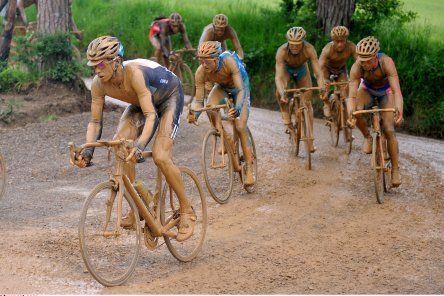
Where others ask “Why”, Angelo asks “Why not”. Starting in Venice or Washington, DC, riding over the Gavia in the snow or the dirt roads to Montalcino or the Kronplatz through rain and mud, he always manages to create a spectacular route for the Giro. Forget the whiners who say this isn’t serious racing, that snow and mud have nothing to do with cycling. This sport is all about epic, memorable moments and about keeping that connection with history, with the years of Magni, Binda and of course Coppi.

Going 20kmh over dirt roads poses no safety risk, other than maybe the occasional flash of insanity. The conditions are beyond bad, yes, but they are equally bad for everybody. In choosing routes where the riders can’t hide, Angelo makes sure that the Giro is an incredibly entertaining race to watch for cycling fans. I pity the fans who ignore the Giro in favor of the Tour. For sure, the Tour is required viewing, but a fan who doesn’t watch the Giro is depriving himself of so much pleasure.

2) It’s a 3 week race that is really raced for 3 weeks
Oftentimes a Grand Tour follows one of two patterns. Either it is decided after one week, and the rest is just a procession to the finish. Or nothing happens in the first two weeks and then the last week has all the fireworks. If you look at the Giros of the past years, they have always had plenty of excitement throughout the three weeks, with the ultimate winner often unclear until the final weekend (or, unfortunately, 1-2 years after if one of the various dope-boys claim initial victory). The Vuelta and the Tour also have their share of exciting editions (remember when Carlos won the 2008 Tour against Evans on the last Saturday), but no Grand Tour has delivered 3 weeks of top-notch racing consistently like the Giro has.

3) Weather
No other race has the weather swings the Giro has. Sure, it the Tour and Vuelta can have a really, really bad day as well (Last year’s Tour stage that Heinrich won comes to mind) but the Giro can go from snow to rain to 35 degrees Celsius in mere days. And when we think back about epic rides, be it from watching the pros or from riding ourselves, isn’t it more often than not the weather that at least played a role in making it epic? So let’s move the Vuelta to December, or back again to April, or something to break away from its monotonous sun-filled stages. A race that reminds you of sipping sangria during the siesta will never beat one that has hot chocolate and a triple layer of rain jackets written all over it.


Classics Time

February 26, 2010
Cold, rain, mud, cobbles – not the sort of environment most cyclists look forward to. But this is my favorite part of the cycling calendar, both to ride outside myself and to watch as a fan. And since we started the TestTeam, it is also the busiest period for testing, because what better place to test products than in bad weather on bad roads. The past four days we had around a dozen partners join the team at our Belgian base to test new prototypes with the riders. I’ve never seen so many new products in one spot, and “luckily” the weather cooperated by swinging from beautiful to nasty and back with regularity.

Of course we also had the next version of the superlight frame there, with some lay-up changes based in part on Thor’s feedback from last months tests, and so we continue to improve that frame and learn for the future. We also did some good work on new tires and tire pressure optimization, the key to a good ride in Flanders and Roubaix.But it all starts with the Omloop Het Volk (or Nieuwsblad) this Saturday. Last year Thor won it, the first ever cobblestones win on an aero bike. For years we were told the aero bikes couldn’t be ridden on the cobbles, we knew this was mostly a mental issue but those are often the most difficult to overcome. New team, new riders, no preconceived notions, and in the end almost all riders rode the S2 on all cobblestone races except Paris-Roubaix. There they rode the RS for more tire clearance. This year will be similar, except that they will mostly ride the S3, with some opting for the R3sl and then the R3 for Roubaix.

What to expect on the racing side? The win in the team classification at Qatar – which despite its high temperatures and exotic locations is a good barometer for these Belgian races – showed the TestTeam is strong again, but for most riders the goals lie a little further into the future than this weekend. Most pundits seem to list Quickstep and Cervelo as the teams to watch here, but I think one should not overlook Sky and Saxobank. They will be very strong in the Spring Classics (well, throughout the year really). Sky will have a blazing start just like we had last year, it’s amazing what happens when you put talented riders in a new, fresh environment. It just brings them to life. And of course Saxobank has an extremely talented line-up of riders, with Cancellara, O’Grady and Breschel to name but three, so they will be a force to be reckoned with. Toss in Lotto and it should make for some exciting racing. Now let’s just hope for some real Flemish weather and let the racing begin.

In the meantime, I’ll go for a few training rides myself this weekend to get ready for the first TestTeamTravel events. Just like last year, I promise people I will ride the Classics with them as an incentive for myself to start training. Last year this didn’t really work, and I ended up doing the Flanders cyclosportive and the Roubaix course with next-to-no training. They were both amazing trips, but I still remember how I felt afterwards, so this year I am a little more committed to the training part. So far …